
Regional Australia PR: Is the 491 Visa's Extra Points Worth the Commitment
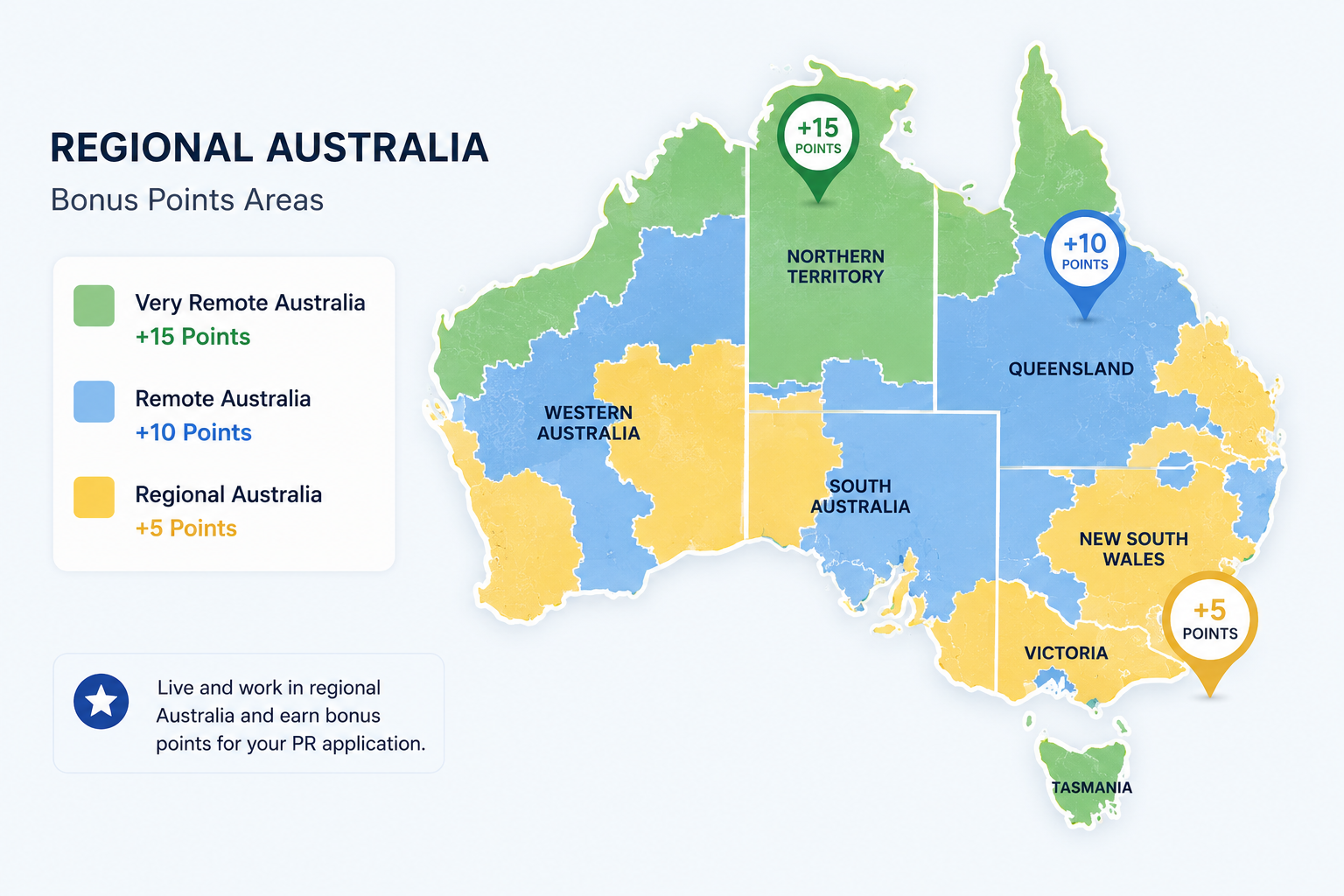
The Subclass 491 Visa offers skilled migrants something rare in Australia's points-tested system an extra 15 points simply for committing to regional living. But those points come with a serious obligation. Before you apply, it's worth understanding exactly what you're signing up for and whether the trade-off makes sense for your situation.
Overview
The Skilled Work Regional (Provisional) Visa (Subclass 491) is a points-tested provisional visa for skilled workers willing to live and work in regional Australia. It is not a permanent visa on its own. Instead, it provides a pathway to permanent residency through the Subclass 191 visa after meeting residency and income requirements over several years.
The 15 bonus points awarded under the 491 visa can be the difference between receiving an invitation and waiting indefinitely in the Expression of Interest (EOI) pool. For applicants sitting just below competitive point thresholds, this can be a genuine game-changer.
Key Eligibility Requirements
- Age: Under 45 years at time of invitation
- Points test score: Minimum 65 points (before regional bonus)
- Skilled occupation: Must appear on a relevant skilled occupation list
- English proficiency: Competent English as a minimum requirement
- Skills assessment: Positive assessment from the relevant assessing authority
- Nomination: Must be nominated by a state or territory government, or sponsored by an eligible family member living in a designated regional area
- Commitment: Must intend to live, work, or study in a designated regional area
Application Process
- Check your occupation: Confirm your occupation is on the relevant skilled occupation list accepted by your nominating state or territory.
- Complete a skills assessment: Lodge your skills assessment with the appropriate assessing body well in advance, as this can take several months.
- Submit your EOI in SkillSelect: Create or update your Expression of Interest and select state or territory nomination or family sponsorship.
- Receive a nomination or sponsorship: Apply through your chosen state or territory's migration program or confirm your eligible family member's sponsorship.
- Receive an invitation to apply (ITA): Once nominated, you will receive an ITA through SkillSelect.
- Lodge your visa application: Submit your application to the Department of Home Affairs within the specified timeframe, typically 60 days from the ITA.
- Await decision: Processing times vary. Keep your documents current during this period.
Required Documents
- Valid passport and travel history
- Positive skills assessment letter
- English language test results (IELTS, PTE, TOEFL, or equivalent)
- Employment references and payslips confirming skilled work experience
- Educational qualifications and transcripts
- State or territory nomination letter or family sponsorship evidence
- Health examination results
- Police clearance certificates from each country lived in for 12 months or more
- Proof of relationship (if applying with family members)
Benefits and Limitations
Benefits
- Extra 15 points can significantly improve your invitation chances in a competitive EOI pool
- Valid for 5 years, giving you time to build your regional life before applying for PR
- Work rights are unrestricted within your designated regional area
- Family members can be included, with the same work and study rights
- Provides a clear, structured pathway to the Subclass 191 permanent visa
- Some regional areas offer strong employment opportunities in healthcare, construction, agriculture, and education
Limitations
- You must live and work in a designated regional area metropolitan cities like Sydney, Melbourne, and Brisbane are excluded
- The pathway to PR requires meeting minimum income and residency conditions over an extended period
- Changing jobs or relocating outside regional areas could affect your compliance and PR eligibility
- Not all occupations are accepted by all states your options may be limited depending on your field
- State nomination is competitive and not guaranteed even with a high points score
- If circumstances change (job loss, family issues), maintaining compliance can become challenging
Common Mistakes to Avoid
- Underestimating the regional commitment: Many applicants don't fully account for lifestyle changes when moving away from major cities.
- Not verifying occupation eligibility per state: Each state has its own occupation list. An occupation approved in one state may not be accepted in another.
- Delaying the skills assessment: Submitting your skills assessment too late can hold up your entire application timeline.
- Ignoring compliance obligations: Travelling outside your regional area frequently or working remotely for a non-regional employer can create compliance risks.
- Submitting an incomplete EOI: Missing or inaccurate information in your SkillSelect profile can lead to lower scores or missed invitations.
- Not tracking state nomination rounds: States open and close their nomination programs at different times. Missing an open round can mean waiting months.
Frequently Asked Questions
Can I move to a major city after getting the 491 visa?
No. As a condition of the 491 visa, you are required to live, work, or study in a designated regional area for the duration of your visa. Moving to a non-regional area could breach your visa conditions and affect your eligibility for the Subclass 191 permanent visa.
What is a designated regional area under the 491 visa?
Designated regional areas generally include most of Australia outside Sydney, Melbourne, and Brisbane. This includes cities like Adelaide, Perth, Hobart, Darwin, Canberra, and the Gold Coast, as well as rural and remote regions. You should verify the specific postcodes with the Department of Home Affairs or your migration agent.
How long do I need to stay in regional Australia before applying for PR?
To be eligible for the Subclass 191 permanent visa, you generally need to have lived and worked in a regional area for a specified period and met the income threshold requirements. You should review the current conditions on the Department of Home Affairs website or consult a registered migration agent for the latest requirements.
Does my family also need to live in a regional area?
Yes. Secondary applicants included in your 491 visa are also subject to regional living conditions. They must reside with you or independently meet regional residency requirements for their own compliance purposes.
Is the 491 visa a good option if I already have a strong points score?
If your points score is already highly competitive without the regional bonus, you may prefer to pursue the Subclass 189 (independent) stream, which has no regional obligations. However, if your score falls in a range where 15 extra points could secure an invitation, the 491 pathway is worth serious consideration alongside a realistic lifestyle assessment.
How Visas Avenue Can Help
Visas Avenue has extensive experience guiding skilled migrants through the 491 visa process from EOI strategy and state nomination advice to full application lodgement. Our registered migration agents can assess your points score, identify the right state nomination opportunity, and help you build a compliant, well-documented application. Contact Visas Avenue today for a professional assessment of your regional migration options.
Conclusion
The 491 visa's 15 bonus points are a real advantage but they come with a genuine lifestyle and legal commitment. For the right candidate, regional Australia offers strong career opportunities, a lower cost of living, and a clear path to permanent residency. The key is making an informed decision based on your occupation, your points score, and your willingness to embrace regional life for the long term.


.png)



Anusha V. Ramani
A group of diligent team members I must say! Very prompt and thorough in their job. Would...

Varun Thomas
Got our Canada PR done and I must say they are really professionals and they know what...

Vinay Upadhaya
Co-operative and Trained Staff to handhold you throughout the process. Mr.Vinay Upadhyay

Runzhun Gangrade
Great service and good support from the entire team. We had a great experience working...

Aakanksha Singh Chauhan
Thank you so much for your help Mrigya & Arpita. You keen sense of dedication to my...

Sanjeev Sharma
Very Professional Consultancy, which has actual meaningful escalation Matrix system for...