
Latest Canada Express Entry Draw: Did You Make the Cutoff
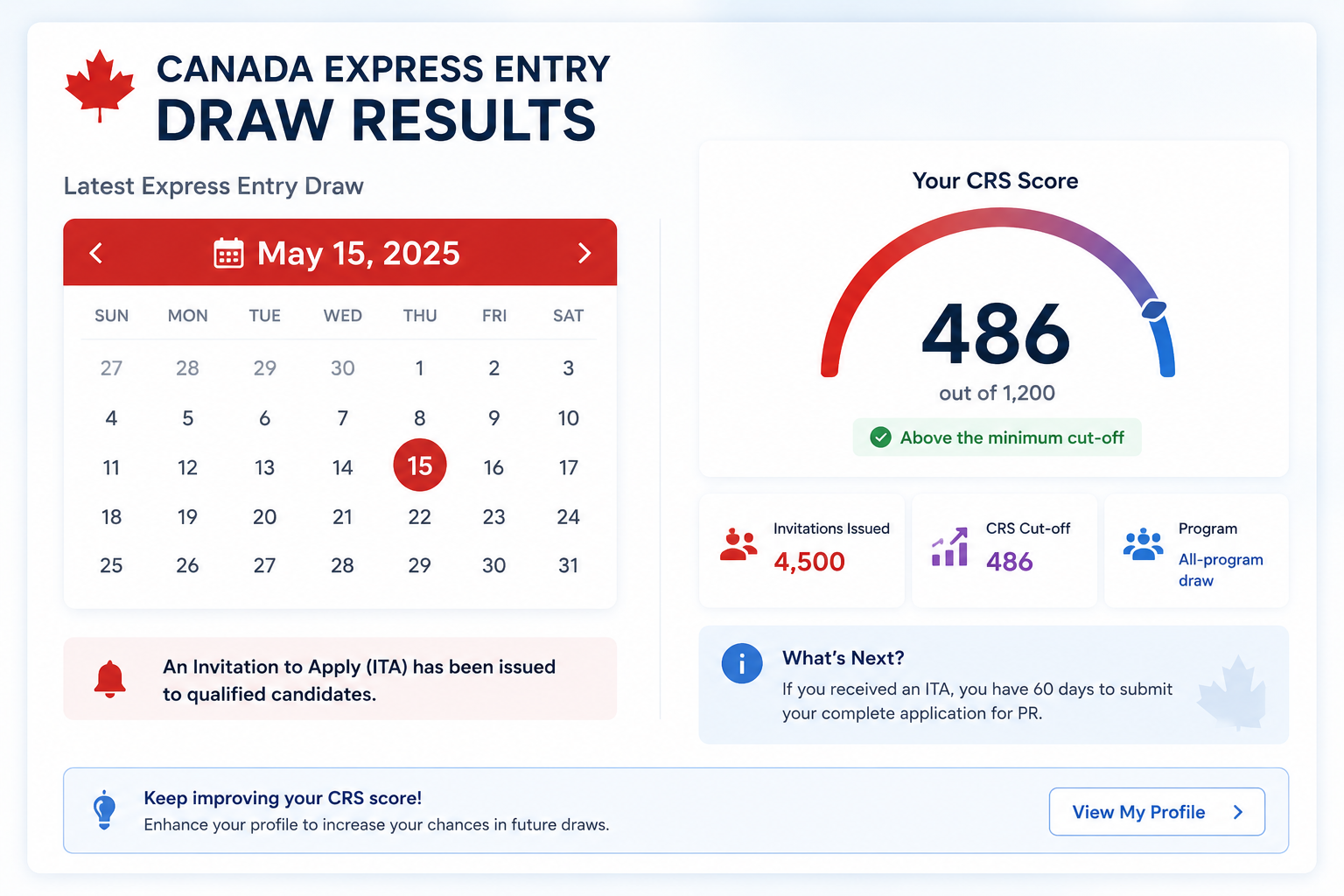
Every new Express Entry draw triggers the same question for thousands of candidates worldwide: did my CRS score make the cutoff? If you are actively sitting in the Express Entry pool, understanding how draws work and what influences cutoff scores can help you plan your next move with confidence.
Overview of Canada Express Entry Draws
Express Entry is Canada's flagship immigration management system for skilled workers. Immigration, Refugees and Citizenship Canada (IRCC) conducts regular draws from the pool of eligible candidates and issues Invitations to Apply (ITAs) for permanent residence.
Each draw targets either all programs or specific streams such as the Canadian Experience Class (CEC), Federal Skilled Worker Program (FSWP), or Provincial Nominee Program (PNP). The cutoff score also called the minimum CRS score determines who receives an ITA in that round.
Key Eligibility Requirements
Before entering the Express Entry pool, candidates must meet the baseline requirements for at least one of the eligible programs. Core criteria include:
- Age: Candidates between 18 and 45 years typically score higher CRS points
- Education: A minimum of secondary education; post-secondary credentials boost your score significantly
- Language proficiency: Valid IELTS, CELPIP (English) or TEF, TCF (French) scores meeting CLB thresholds
- Work experience: At least one year of skilled work experience in NOC TEER 0, 1, 2, or 3 occupations
- Adaptability factors: Canadian work experience, study permits, or a spouse with strong credentials can add points
- Provincial Nomination: A valid provincial nomination adds 600 CRS points, practically guaranteeing an ITA
Application Process
If you receive an ITA, you must act quickly and accurately. Here is the standard process from pool entry to permanent residence application:
- Create your Express Entry profile Submit your profile on the IRCC portal with accurate language scores, education, and work history
- Enter the pool Your Comprehensive Ranking System (CRS) score is calculated automatically based on your profile information
- Wait for an Invitation to Apply (ITA) Monitor draw results regularly; IRCC typically conducts draws every two weeks
- Accept your ITA You have a limited window (usually 60 days) to accept the invitation
- Gather and submit documents Compile all required supporting documents and submit your complete PR application online
- Biometrics and medical exam Complete biometrics collection and an Immigration Medical Examination (IME) with an approved panel physician
- Await a decision IRCC reviews your application and may request additional information
- Receive Confirmation of Permanent Residence (COPR) Upon approval, you receive your COPR and can land in Canada as a permanent resident
Required Documents
Preparing documents in advance reduces errors and prevents delays after you receive an ITA. Commonly required documents include:
- Valid passport (all pages)
- Language test results (IELTS, CELPIP, TEF, or TCF)
- Educational Credential Assessment (ECA) report from a designated organization
- Reference letters from employers detailing job duties, hours, and salary
- Proof of funds (bank statements or equivalent)
- Police clearance certificates from all countries where you lived for six months or more after age 18
- Immigration Medical Examination results from an approved panel physician
- Birth certificates and marriage certificates (if applicable)
- Provincial Nomination certificate (if applicable)
Benefits and Limitations
Benefits
- One of the fastest pathways to Canadian permanent residence
- No employer sponsorship required for most programs
- Covers skilled workers across a wide range of occupations
- French-language proficiency can significantly boost your CRS score
- Provincial nominations provide a near-certain route to an ITA
- Successful applicants gain access to Canada's healthcare, education, and social systems as permanent residents
Limitations
- Cutoff scores fluctuate based on pool composition and government targets
- No guaranteed timeline for receiving an ITA if your score is borderline
- Language and education assessments involve cost and time
- Candidates without Canadian experience or a PNP may face extended wait times
- Draws can be paused or modified without advance notice
Common Mistakes to Avoid
Small errors in your Express Entry profile or application can cost you points or result in refusal. Avoid these frequent pitfalls:
- Inaccurate job descriptions: Ensure your NOC code accurately reflects your primary job duties
- Expired language scores: Most test results are valid for two years; check expiry dates before submitting
- Missing documents after ITA: Compile all documents before receiving an ITA to avoid last-minute gaps
- Incorrect proof of funds: Funds must be accessible and unencumbered; tied investments may not qualify
- Not updating your profile: Changes in job, education, or marital status must be reflected immediately
- Ignoring provincial streams: Many provinces run targeted draws with lower score requirements
Frequently Asked Questions
How often does IRCC conduct Express Entry draws?
IRCC generally holds draws every two weeks, though the frequency can vary. Some periods see more frequent draws, while others experience pauses. It is advisable to check the official IRCC website regularly for the latest draw announcements.
What happens if my CRS score is below the cutoff?
If your score falls below the cutoff, you remain in the pool and are considered for future draws. You can work on improving your score by retaking language tests, gaining additional work experience, pursuing further education, or exploring provincial nomination options.
Does a provincial nomination guarantee an ITA?
A valid provincial nomination adds 600 CRS points to your score, which in practice brings most candidates well above any historical cutoff threshold. However, you still need to be eligible for Express Entry and hold an active profile in the pool.
Can I apply to multiple provincial streams while in the Express Entry pool?
Yes. Being in the Express Entry pool does not prevent you from applying to provincial streams simultaneously. In fact, pursuing a provincial nomination is one of the most effective strategies for candidates with mid-range CRS scores.
How long is an ITA valid after I receive it?
Once you receive an Invitation to Apply, you typically have 60 days to submit a complete permanent residence application. Missing this deadline means your ITA expires and you return to the pool, potentially with a lower CRS score if your profile details have changed.
How Visas Avenue Can Help
Navigating Express Entry draw cycles, CRS score optimization, and document preparation can be complex without the right guidance. Visas Avenue's experienced immigration consultants provide personalized CRS assessments, help identify the right program pathway for your profile, and guide you through every step from pool entry to permanent residence approval. Book a free consultation today to understand exactly where you stand and what your next best move is.
Conclusion
Express Entry remains one of Canada's most efficient and transparent routes to permanent residence for skilled workers globally. Whether your score cleared the latest cutoff or you are working toward a stronger profile, consistent preparation and expert advice make all the difference. Stay informed, keep your profile updated, and take proactive steps to maximize your CRS score before the next draw.






Anusha V. Ramani
A group of diligent team members I must say! Very prompt and thorough in their job. Would...

Varun Thomas
Got our Canada PR done and I must say they are really professionals and they know what...

Vinay Upadhaya
Co-operative and Trained Staff to handhold you throughout the process. Mr.Vinay Upadhyay

Runzhun Gangrade
Great service and good support from the entire team. We had a great experience working...

Aakanksha Singh Chauhan
Thank you so much for your help Mrigya & Arpita. You keen sense of dedication to my...

Sanjeev Sharma
Very Professional Consultancy, which has actual meaningful escalation Matrix system for...