
German Language Level for Opportunity Card: Do You Need A1, A2, or B1
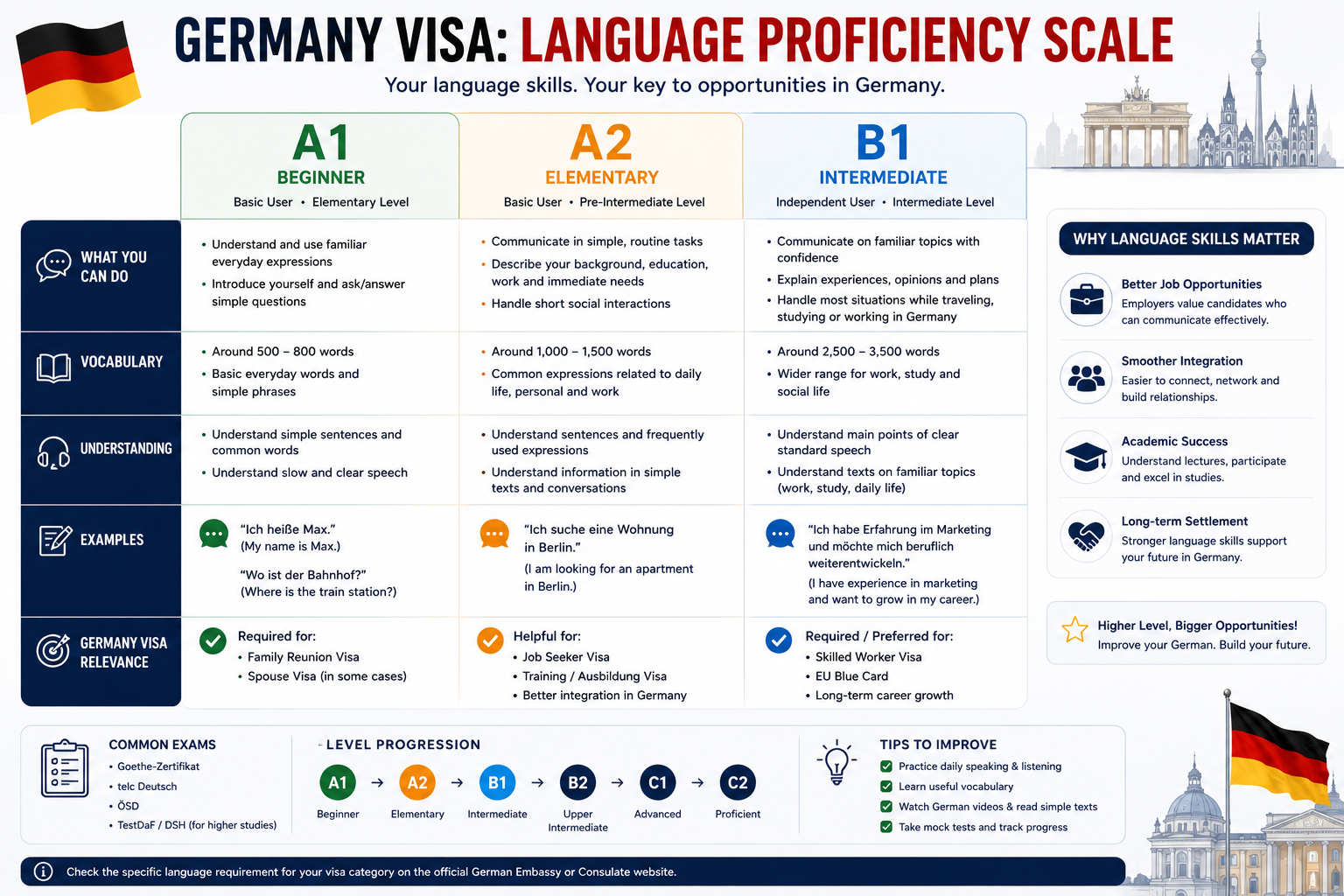
If you are planning to apply for Germany's Opportunity Card (Chancenkarte), one of the first questions you will face is how much German you actually need to know. The answer depends on your overall points score and how you plan to meet the eligibility threshold. German language skills are not always mandatory, but they can significantly strengthen your application.
Overview
The Opportunity Card is a points-based job seeker visa that allows skilled workers to enter Germany and search for employment for up to one year. It is not a work visa itself, but a temporary residence permit for job hunting purposes.
To qualify, applicants must meet a minimum points threshold. Language ability is one of the scoring criteria, and depending on your profile, German or English proficiency can earn you additional points.
Key Eligibility Requirements
Before discussing language levels in detail, it helps to understand the broader eligibility picture:
- Recognised qualification: A university degree or vocational qualification recognised in Germany or comparable to German standards
- Financial means: Proof that you can financially support yourself during your stay in Germany
- Points score: You must reach the required points threshold through a combination of criteria
- No criminal record: Clean background as assessed by German immigration authorities
- Valid travel document: A passport that remains valid for the intended stay
The points criteria include German language skills, English proficiency, work experience, age, connection to Germany, and potential employability in shortage occupations.
German Language Levels and How They Score
German language proficiency is assessed using the Common European Framework of Reference (CEFR) scale. Here is how different levels typically contribute to your Opportunity Card points:
| Language Level | CEFR Standard | Points Contribution |
|---|---|---|
| Basic German | A1 or A2 | Lower points, but still credited |
| Intermediate German | B1 or B2 | Higher points awarded |
| Advanced German | C1 or above | Maximum language points |
| English Proficiency | B2 or above | Points credited as alternative |
You do not need a specific minimum level of German to apply. However, higher language proficiency will earn you more points, making it easier to meet the threshold.
Do You Need A1, A2, or B1?
There is no single mandatory German language level for the Opportunity Card. The requirement depends on your total points profile:
- A1 or A2: These basic levels earn fewer points. If you have strong scores in other categories such as age, work experience, or a recognised qualification in a shortage occupation, A1 or A2 may be sufficient to reach the threshold.
- B1: This intermediate level is a practical target for most applicants. It demonstrates conversational ability and earns a meaningful points contribution.
- B2 and above: These higher levels give you the strongest language score and improve your overall competitiveness.
- No German at all: If you have strong English skills at B2 or above, and score highly in other criteria, it may still be possible to qualify without German proficiency.
In practical terms, most immigration consultants recommend aiming for at least A2 or B1 in German to give your application a comfortable points buffer.
Application Process
- Assess your points score: Use the official points calculator or consult an immigration adviser to estimate your current score.
- Identify your language gap: Determine whether German or English proficiency needs to be improved to meet the threshold.
- Complete a recognised language course: Enrol in a certified German language course and obtain an official certificate such as Goethe-Zertifikat or TestDaF.
- Gather all supporting documents: Compile qualification certificates, work experience proof, financial documents, and your language certificate.
- Submit your visa application: Apply at the German embassy or consulate in your home country.
- Attend your visa interview: Some applicants may be called for an interview as part of the process.
- Receive your Opportunity Card: Once approved, you can travel to Germany and begin your job search.
Required Documents
- Valid passport with sufficient validity period
- Completed visa application form
- Passport-sized photographs meeting German specifications
- Recognised academic or vocational qualification certificates
- Proof of work experience (employment letters, contracts)
- Language proficiency certificate (Goethe, telc, TestDaF, IELTS, or equivalent)
- Proof of financial means (bank statements or blocked account confirmation)
- Health insurance cover for the duration of stay
- Curriculum vitae in German or English
Benefits and Limitations
Benefits
- Allows you to enter Germany legally and search for a job in person
- Valid for up to one year, giving ample time for job hunting
- Language flexibility means even basic German or strong English can contribute
- Points system is transparent and allows applicants to plan ahead
- Opens the door to a wide range of skilled employment opportunities in Germany
Limitations
- Does not guarantee a job or permanent residence
- You must have sufficient funds to support yourself throughout your stay
- Work rights during the Opportunity Card period are restricted
- Qualification recognition can be a lengthy process and must often be addressed before applying
- Language certificates must be from approved institutions and may require preparation time
Common Mistakes to Avoid
- Assuming German is mandatory: Many applicants drop out thinking they need fluent German. The points system offers flexibility.
- Submitting unrecognised language certificates: Always use certificates from approved testing bodies.
- Underestimating financial proof requirements: Authorities want clear evidence you can support yourself without working.
- Not verifying qualification recognition: An unrecognised qualification may disqualify your application entirely.
- Applying without calculating your points first: Always confirm you meet the threshold before investing in the application process.
- Using outdated application forms: German immigration requirements can be updated. Always source forms from the official German embassy website.
Frequently Asked Questions
Is German language mandatory for the Opportunity Card?
No, German language proficiency is not strictly mandatory. It is one of several scoring criteria. If you score highly in other areas such as age, work experience, or professional qualifications, you may qualify without German skills, particularly if you hold strong English proficiency at B2 level or above.
Which German language certificate is accepted for the Opportunity Card?
Certificates from recognised institutions such as the Goethe-Institut, telc, TestDaF, and SD are generally accepted. It is advisable to confirm accepted certificates with the German embassy in your country before applying.
Will A1 German be enough to qualify?
A1 German will earn you some points, but it is a lower-scoring level. Whether it is enough depends entirely on your overall points profile. If you have strong qualifications, relevant work experience, and fall within a preferred age bracket, A1 may contribute sufficiently alongside your other scores.
Can I improve my German language level after submitting my application?
Your language certificate must be valid and submitted as part of your application. You cannot update your language score after submission. It is important to achieve your target language level before applying.
Does English proficiency count instead of German for the Opportunity Card?
Yes, English proficiency at B2 level or above can contribute to your points score as an alternative to German. However, strong German language skills generally earn more points and will also improve your practical ability to find employment once you are in Germany.
How Visas Avenue Can Help
Navigating the Opportunity Card points system, understanding which language level you need, and preparing a complete application can be complex. Visas Avenue's immigration experts can evaluate your profile, calculate your points score, identify gaps, and guide you through every step of the application process. Our team ensures your documents meet German embassy standards before submission.
Conclusion
The German language requirement for the Opportunity Card is flexible rather than fixed. Whether A1, A2, or B1 is right for you depends on your full points profile. Investing in at least a B1 certificate is a practical step that strengthens most applications. If you are unsure about your eligibility, speak with a qualified immigration consultant before making your move.




Anusha V. Ramani
A group of diligent team members I must say! Very prompt and thorough in their job. Would...

Varun Thomas
Got our Canada PR done and I must say they are really professionals and they know what...

Vinay Upadhaya
Co-operative and Trained Staff to handhold you throughout the process. Mr.Vinay Upadhyay

Runzhun Gangrade
Great service and good support from the entire team. We had a great experience working...

Aakanksha Singh Chauhan
Thank you so much for your help Mrigya & Arpita. You keen sense of dedication to my...

Sanjeev Sharma
Very Professional Consultancy, which has actual meaningful escalation Matrix system for...