
Canada PNP Explained: Provincial Pathways That Don't Require a Job Offer
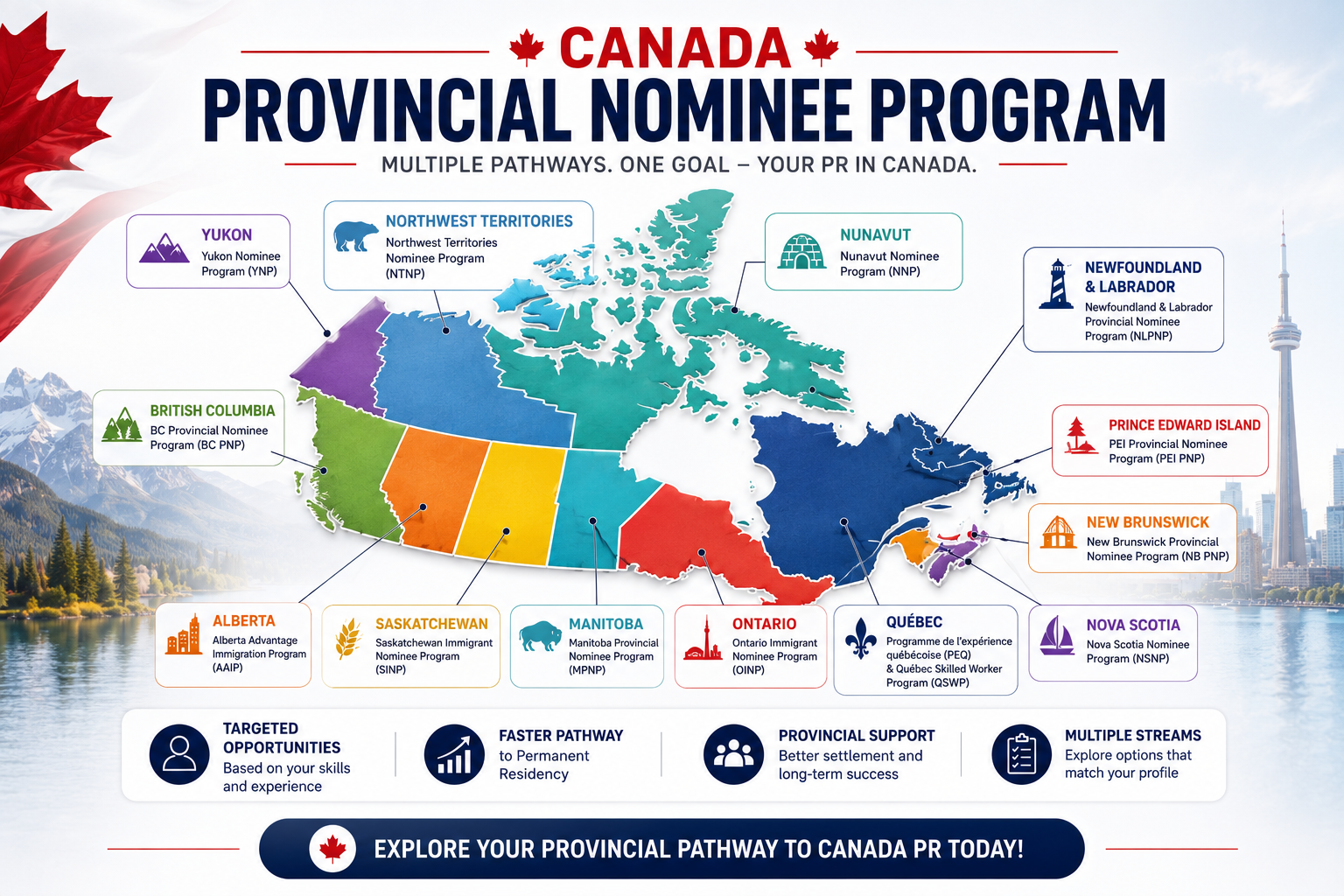
Many skilled workers assume a Canadian job offer is mandatory for provincial immigration. It is not. Several Provincial Nominee Program (PNP) streams allow you to apply without one and some of them offer faster processing than federal routes.
Overview
The Canada PNP allows individual provinces and territories to nominate skilled workers, graduates, and entrepreneurs for permanent residency. Each province manages its own streams with its own criteria.
While some streams do prioritize candidates with job offers, a significant number focus on occupation, education, language ability, and adaptability factors instead. Understanding which streams apply to your profile can open doors you may not have considered.
Key Eligibility Requirements
Requirements vary by province and stream, but most no-job-offer pathways share common baseline criteria:
- Education: A post-secondary credential is typically required, often at diploma or degree level
- Work Experience: Skilled work experience in an eligible occupation, usually within the past few years
- Language Proficiency: A valid IELTS or CELPIP score meeting the stream's minimum threshold
- Settlement Funds: Proof that you can financially support yourself and dependants upon arrival
- Genuine Intent to Reside: A credible plan to settle in the nominating province
- Express Entry Profile (for Enhanced Streams): Many provinces draw from the federal Express Entry pool, so a valid profile may be required
Application Process
The steps below reflect a general pathway. Always verify current requirements on the official provincial immigration website before applying.
- Research eligible streams: Identify provinces with streams matching your occupation, education, and language scores
- Create an Express Entry profile: Required for Enhanced PNP streams aligned with federal programs
- Submit a provincial Expression of Interest (EOI): Some provinces run their own EOI pools separate from federal Express Entry
- Receive a Notification of Interest (NOI) or Invitation to Apply (ITA): The province contacts eligible candidates from its pool
- Submit your provincial nomination application: Complete the online or paper application with all required documents
- Receive a Provincial Nomination Certificate: If approved, the province nominates you for permanent residency
- Apply for Canadian Permanent Residency: Submit your PR application to Immigration, Refugees and Citizenship Canada (IRCC)
Required Documents
Document requirements differ by stream and province. Commonly requested documents include:
- Valid passport and travel history
- Educational credential assessments (ECA) from a designated body
- Language test results (IELTS, CELPIP, or TEF for French)
- Employment reference letters detailing job duties, salary, and duration
- Proof of settlement funds (bank statements or financial records)
- Police clearance certificates
- Proof of intent to reside in the nominating province
- Completed provincial application forms
Benefits and Limitations
Benefits
- No job offer required eligible candidates can apply based on skills and profile alone
- Provinces with lower competition may have more accessible draw thresholds
- Enhanced PNP nominations significantly boost CRS scores in Express Entry
- Multiple provinces run streams targeting a wide range of occupations and sectors
- Some streams specifically support international graduates from Canadian institutions
- French-language streams offer additional pathways in several provinces
Limitations
- You must genuinely intend to live in the nominating province, at least initially
- Each province has its own draw schedule invitations are not guaranteed or predictable
- Some high-demand streams receive more applicants than available nominations
- Processing timelines vary and are subject to change
- Provincial nomination does not guarantee federal PR approval IRCC conducts its own assessment
- Credential recognition requirements can add time and cost to the process
Common Mistakes to Avoid
- Applying to the wrong stream: Carefully verify that your NOC code or occupation is eligible before submitting
- Submitting outdated language scores: Most streams require test results within a specific validity window
- Ignoring the intent-to-reside requirement: Officers assess whether your settlement plan is genuine
- Incomplete documentation: Missing a single document can delay or disqualify your application
- Assuming all PNP streams are the same: Each province operates independently research is essential
- Not maintaining your Express Entry profile: For Enhanced streams, an expired or inactive profile removes you from draw consideration
Frequently Asked Questions
Can I apply to multiple provinces at the same time?
Yes, in most cases. You can submit Expressions of Interest to multiple provinces simultaneously, as long as you meet each stream's requirements. However, you can only hold one active provincial nomination at a time.
Which provinces are known to have no-job-offer streams?
Several provinces including Ontario, British Columbia, Alberta, Saskatchewan, Nova Scotia, and Prince Edward Island operate streams that do not require a job offer. Eligibility criteria and draw frequency vary significantly between them.
Does a provincial nomination guarantee permanent residency?
No. A provincial nomination is a strong supporting factor, but IRCC conducts an independent federal assessment. Candidates must still meet health, security, and admissibility requirements.
What is the difference between a Base PNP and an Enhanced PNP stream?
Base PNP streams operate independently of Express Entry and result in a paper-based PR application. Enhanced PNP streams are linked to Express Entry receiving a nomination adds a significant number of points to your CRS score and typically speeds up the federal PR process.
How long does the full PNP process take?
Timelines depend on the province, the stream type, and IRCC's federal processing queue. Processing times can range from several months to over a year in total. Always check current processing times on the official IRCC and provincial websites.
How Visas Avenue Can Help
Navigating multiple provincial streams, eligibility criteria, and documentation requirements on your own is complex. Visas Avenue provides end-to-end immigration support from identifying the right PNP stream for your profile to preparing a complete, submission-ready application. Our experienced immigration consultants help you avoid costly mistakes and present the strongest possible case to the province and IRCC.
Conclusion
A job offer is not the only route to Canadian permanent residency through the PNP. If you have strong language skills, relevant work experience, and the right educational background, a provincial pathway without a job offer may be well within reach. Start by identifying which streams align with your profile and seek professional guidance to move forward with confidence.






Anusha V. Ramani
A group of diligent team members I must say! Very prompt and thorough in their job. Would...

Varun Thomas
Got our Canada PR done and I must say they are really professionals and they know what...

Vinay Upadhaya
Co-operative and Trained Staff to handhold you throughout the process. Mr.Vinay Upadhyay

Runzhun Gangrade
Great service and good support from the entire team. We had a great experience working...

Aakanksha Singh Chauhan
Thank you so much for your help Mrigya & Arpita. You keen sense of dedication to my...

Sanjeev Sharma
Very Professional Consultancy, which has actual meaningful escalation Matrix system for...