
Three Real Profiles, Three Different Countries: See What Worked
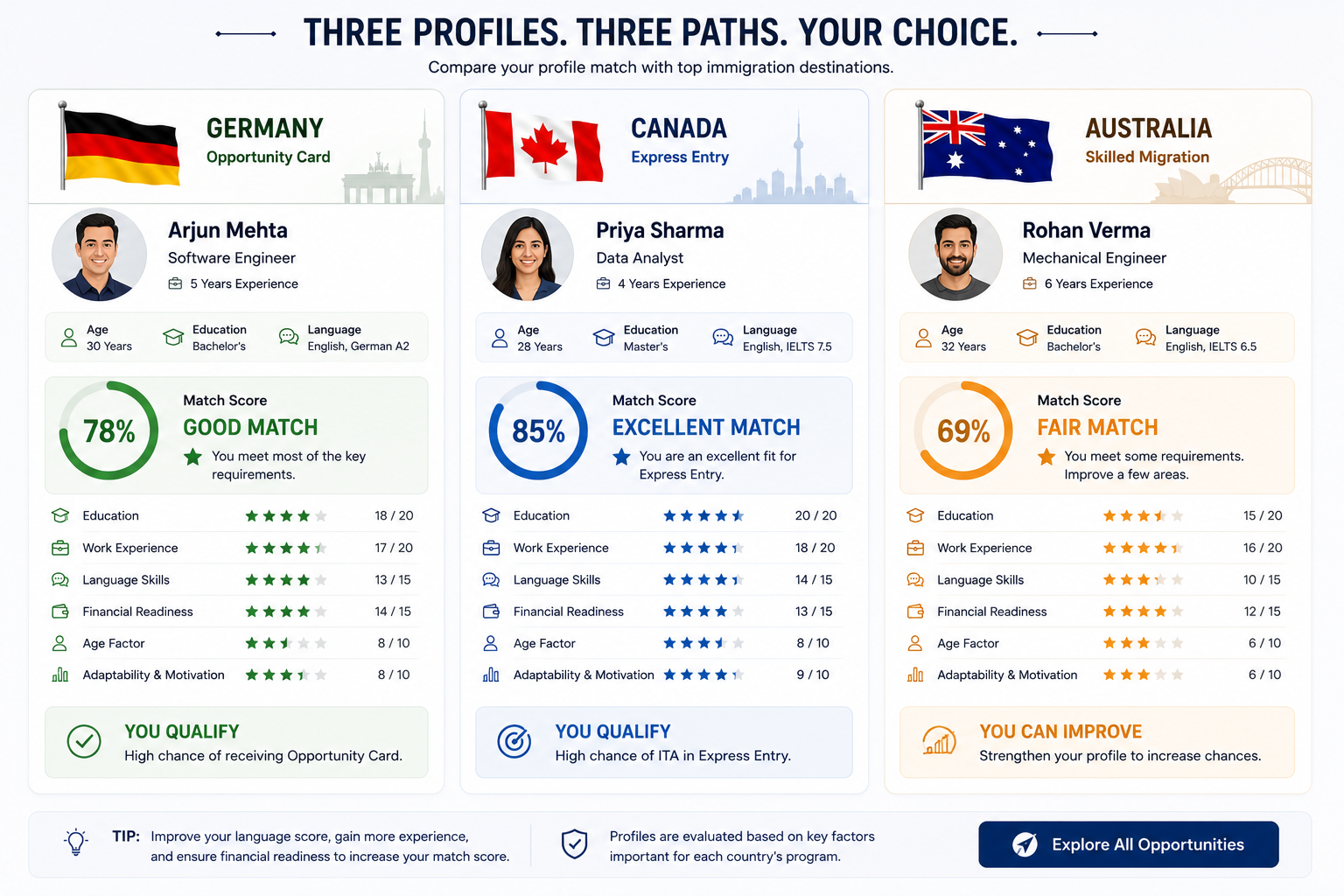
Most immigration guides tell you what the rules are. This one shows you what actually worked for three real applicant types, across three different destination countries. If you have been wondering which pathway fits your background, these profiles will help you think more clearly.
Overview
Every immigration journey is shaped by a unique combination of age, education, work experience, language ability and family situation. No two applicants are identical, and no single country is the right fit for everyone.
The three profiles below are representative examples based on common applicant types we work with. They are not fictional extremes they reflect real situations that immigration consultants encounter regularly.
Key Eligibility Requirements
Before diving into the profiles, here are the core factors that most skilled immigration pathways evaluate:
- Age: Younger applicants typically score higher in points-based systems
- Education: Degrees recognised in the destination country carry more weight
- Work experience: Skilled occupation history in relevant fields is essential
- Language proficiency: IELTS, PTE, TOEFL or equivalent scores matter significantly
- Job offer: A valid offer from an employer in the destination country can be decisive
- Adaptability: Spouse qualifications, prior study or previous time spent in the country
Application Process
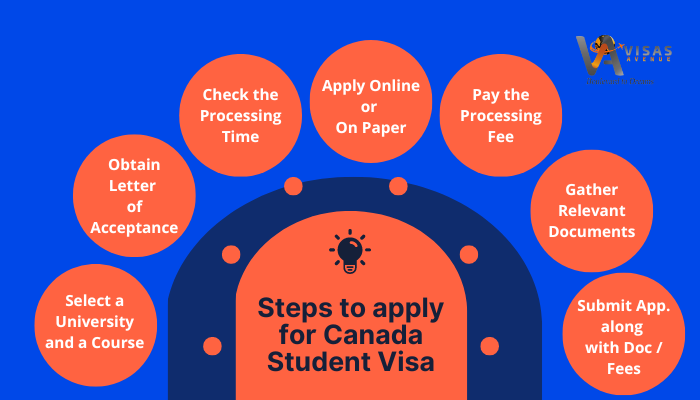
While each country has its own system, the general flow for skilled migration looks like this:
- Assess your profile against the target country's eligibility criteria
- Take the required language test and obtain your score
- Get your educational credentials evaluated or recognised
- Submit an Expression of Interest or register in the relevant immigration portal
- Receive an invitation to apply if shortlisted
- Compile and submit your full application with supporting documents
- Attend a medical examination and provide biometrics if required
- Await a decision and respond promptly to any requests for additional information
Profile One: The IT Professional Heading to Canada
Background: 29-year-old software developer, five years of experience, bachelor's degree in computer science, IELTS score of 7.5 overall, no prior Canadian study or work history.
This profile is well-suited to Canada's Express Entry system, specifically the Federal Skilled Worker stream. The combination of a high-demand occupation, strong language scores and relevant education creates a competitive foundation.
- Completing a credential assessment through a recognised body like WES was a critical early step
- Registering a complete Express Entry profile without a job offer was still viable given the overall strength of the profile
- Provincial Nominee Programs offered an additional pathway to improve overall standing
Profile Two: The Nurse Relocating to Australia
Background: 34-year-old registered nurse, eight years of clinical experience, overseas nursing qualification, PTE score of 65, no Australian work history.
Australia's skilled migration system includes specific pathways for healthcare workers. However, the key challenge for this profile was getting the nursing qualification assessed and registered through the relevant nursing authority before lodging a visa application.
- Skills assessment through the relevant nursing body was mandatory before any visa lodgement
- State nomination through a state or territory government added significant value to this application
- Demonstrating evidence of recent clinical practice was important for skills assessment approval
- English language requirements for healthcare professionals are assessed more strictly
Profile Three: The Engineer Moving to Germany
Background: 38-year-old mechanical engineer, twelve years of experience, master's degree from a non-EU university, B2 level German language proficiency, no prior EU work history.
Germany's skilled worker visa for non-EU nationals requires formal recognition of qualifications by the relevant German authority. This step can take several months and should be started well in advance of any visa application.
- Applying for qualification recognition through the relevant German authority was the first and most time-consuming step
- A confirmed employment contract with a German employer was required before the visa could be processed
- German language skills at B2 level were sufficient for many engineering roles, though some employers required C1
- The EU Blue Card was a viable option given the applicant's education level and the salary offered by the employer
Required Documents
Across all three profiles, these documents were consistently required:
- Valid passport with sufficient remaining validity
- Educational certificates and transcripts
- Skills assessment or credential recognition letter
- Language test results
- Employment reference letters detailing roles and responsibilities
- Updated CV or resume
- Police clearance certificates
- Medical examination results
- Proof of funds or financial statements where applicable
Benefits and Limitations
Benefits
- Each country offers a structured pathway that rewards genuine skilled applicants
- Points-based systems provide transparency about where you stand before you apply
- Many pathways lead to permanent residency and eventual citizenship
- Dependent family members can often be included in the same application
Limitations
- Processing times can be unpredictable and are subject to change
- Qualification recognition processes can be lengthy and are not always guaranteed
- Meeting minimum requirements does not guarantee an invitation or approval
- Occupation lists and program conditions can be updated with limited notice
Common Mistakes to Avoid
- Starting the credential assessment process too late and missing application windows
- Submitting language test scores that are close to the minimum without room for error
- Providing vague employment reference letters that do not clearly describe duties and duration
- Choosing a country based on popularity rather than personal profile fit
- Ignoring provincial, state or regional nomination options that could strengthen an application
- Failing to update an Expression of Interest profile when circumstances change
Frequently Asked Questions
Can I apply to more than one country at the same time?
Yes. There is no rule preventing you from pursuing immigration pathways in multiple countries simultaneously. Many applicants keep their options open across two or three countries and proceed with whichever receives approval first.
What if my occupation is not on a priority list?
Not all pathways require your occupation to appear on a specific list. Some streams assess your occupation in combination with other factors such as employer sponsorship, state nomination or job offer. Speak with a registered consultant to explore your specific options.
Does age significantly affect my chances?
Age is a factor in points-based systems, and younger applicants often receive higher scores for this criterion. However, strong work experience, education and language scores can compensate. Age alone is rarely a disqualifying factor.
How long does the entire process typically take?
Timelines vary considerably depending on the country, the visa stream and individual circumstances. Some pathways move faster when a job offer or state nomination is involved. Starting early and preparing thoroughly is the best way to avoid unnecessary delays.
What is the most important thing I can do before applying?
Get a professional assessment of your profile before investing time and money in an application. Understanding your strengths, gaps and realistic options upfront saves significant effort and helps you choose the right pathway from the start.
How Visas Avenue Can Help
At Visas Avenue, our registered immigration consultants assess your complete profile before recommending a pathway. We handle everything from credential evaluation to document preparation and submission, reducing the risk of errors that could delay or affect your application.
Whether your situation resembles one of the profiles above or is entirely different, our team will map out a realistic strategy based on your actual background not a generic checklist.
Conclusion
Immigration is not a one-size-fits-all process. The right country and pathway depend on your specific age, qualifications, experience and goals. These three profiles show that success is possible across very different backgrounds what matters is choosing the right strategy and preparing thoroughly from the start.




Anusha V. Ramani
A group of diligent team members I must say! Very prompt and thorough in their job. Would...

Varun Thomas
Got our Canada PR done and I must say they are really professionals and they know what...

Vinay Upadhaya
Co-operative and Trained Staff to handhold you throughout the process. Mr.Vinay Upadhyay

Runzhun Gangrade
Great service and good support from the entire team. We had a great experience working...

Aakanksha Singh Chauhan
Thank you so much for your help Mrigya & Arpita. You keen sense of dedication to my...

Sanjeev Sharma
Very Professional Consultancy, which has actual meaningful escalation Matrix system for...