
Self-Assessed vs Verified PR Score: Why the Difference Matters
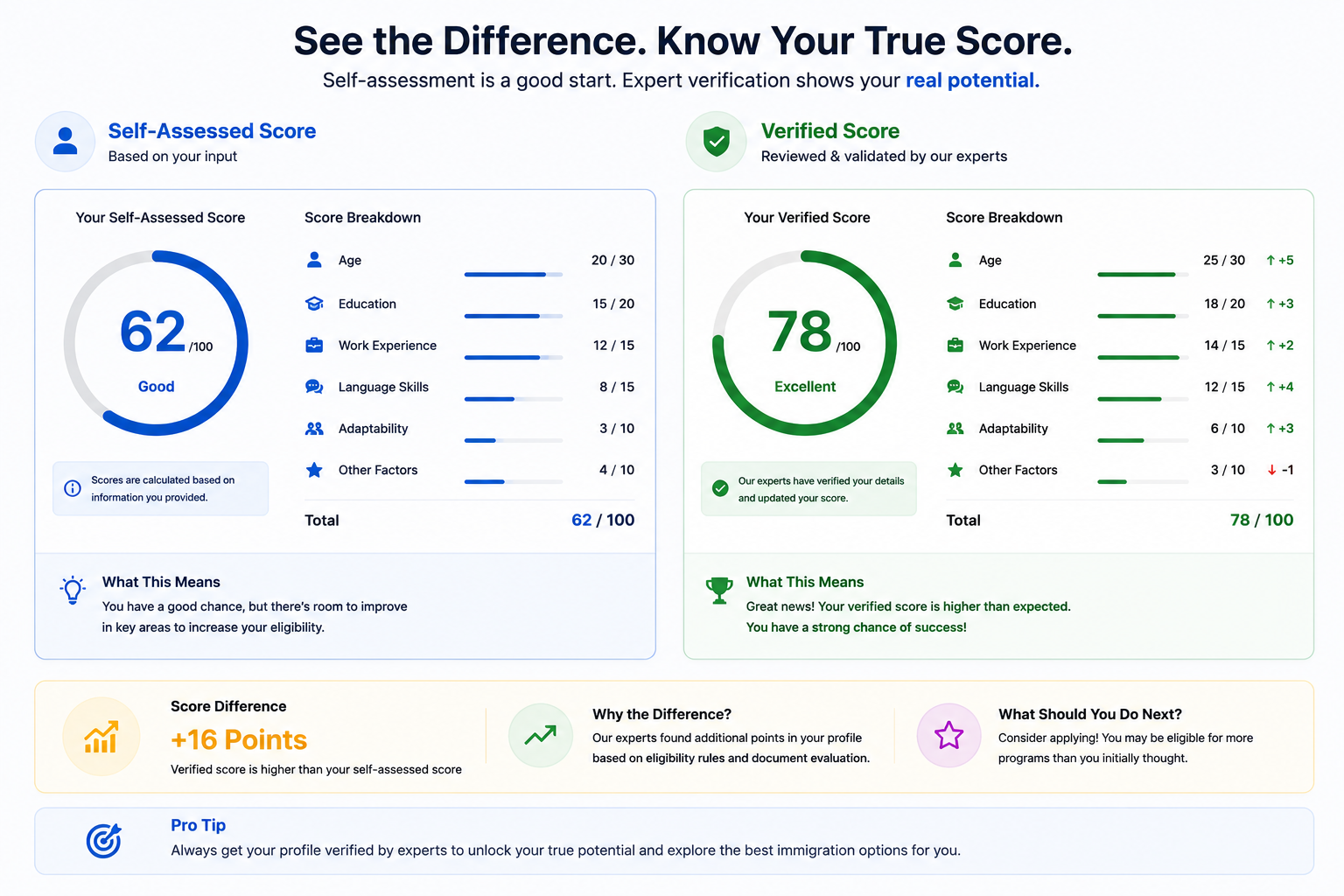
Many applicants are surprised to find that their verified PR score is lower than what they calculated themselves. This gap can cost you an invitation to apply or delay your immigration journey significantly. Understanding why this difference occurs and how to avoid it is one of the most practical steps you can take before submitting your profile.
Overview
In points-based immigration systems like Canada's Express Entry, your score determines whether you receive an Invitation to Apply (ITA) for permanent residence. Applicants first calculate a self-assessed score based on their own understanding of the eligibility criteria.
Once an ITA is issued and documents are submitted, immigration authorities verify every claim. The score calculated during this verification stage is your verified PR score. If it is lower than your self-assessed score, your application may be refused.
Key Eligibility Requirements
To understand where score differences arise, you need to know what factors are evaluated in a typical points-based PR system:
- Age: Points are awarded based on your age at the time of application, not profile creation
- Education: Credentials must be assessed by a recognised authority such as an ECA provider
- Language proficiency: Only approved test results from valid, unexpired tests are accepted
- Work experience: Must meet specific NOC or ANZSCO classifications and be verifiable through documents
- Job offer: Must be genuine, from an eligible employer, and supported by official documentation
- Adaptability factors: Such as prior study, previous work in the destination country, or family ties
Each of these factors carries specific rules. A small misinterpretation in any category can reduce your score significantly.
Application Process
Here is a simplified view of how the scoring process works from start to finish:
- Create your immigration profile and enter your personal, educational, and professional details
- Calculate your preliminary score using the official points calculator or system criteria
- Submit your profile and enter the relevant pool of candidates
- Receive an ITA if your score meets or exceeds the draw cutoff
- Gather and upload all supporting documents within the specified deadline
- Immigration authorities review and verify every claim against your submitted evidence
- A verified score is calculated this becomes the official score for your application
- If the verified score meets the required threshold, your application proceeds to approval
Required Documents
The following documents are typically required to verify your claimed score points:
- Educational Credential Assessment (ECA) report from an approved body
- Official language test results (IELTS, CELPIP, TEF, or equivalent)
- Employment reference letters on company letterhead with job title, duties, hours, and salary
- Pay slips, tax records, or bank statements to support work experience claims
- Valid job offer letter with employer registration or LMIA details where applicable
- Proof of prior study or work in the destination country if claiming adaptability points
- Marriage or civil union certificate if claiming spousal points
- Passport copies valid for the duration of the application
Benefits and Limitations
Benefits
- Self-assessment helps you understand where you stand before investing time and money
- Identifying score gaps early gives you time to improve specific factors like language scores
- Accurate self-assessment increases confidence when submitting your profile
- Verified scoring provides a fair, standardised evaluation for all applicants
Limitations
- Self-assessment tools may not reflect the latest policy updates or occupational classifications
- Minor errors in interpreting criteria can lead to an inflated self-assessed score
- Verified scores are final disputes require formal reconsideration processes
- A lower verified score after receiving an ITA can result in application refusal with fees already paid
Common Mistakes to Avoid
- Claiming wrong NOC or occupation code: Your job duties, not just your job title, determine your classification
- Using expired language test scores: Most tests are valid for only two years from the date of the test
- Overestimating education points: A degree earned abroad must be assessed self-declared equivalency is not accepted
- Including unverifiable work experience: Freelance or self-employment claims require additional supporting evidence
- Miscalculating spousal factors: Spousal language and education points apply only in specific circumstances
- Ignoring document format requirements: Reference letters must follow prescribed formats or they may be rejected
- Not updating your profile after changes: Life events like a new job or improved test score must be reflected promptly
Frequently Asked Questions
What causes the biggest gap between self-assessed and verified PR scores?
The most common causes are incorrect NOC classification, expired or invalid language test scores, and education credentials that have not been formally assessed. These three factors alone can reduce a score by a significant margin.
Can I resubmit my application if my verified score falls short?
Generally, if your application is refused due to a lower verified score, you would need to re-enter the candidate pool. You cannot simply correct and resubmit the same application after a refusal decision is made.
How do I know if my work experience will be verified correctly?
Your employment reference letters should clearly state your job title, duties, hours worked per week, and duration of employment. The duties listed must align with the official description for your claimed occupation code.
Does a higher self-assessed score guarantee an ITA?
No. Your self-assessed score only determines whether you may be competitive in the current draw environment. An ITA depends on draw cutoffs, which vary with each round. Only verified scores count towards final approval.
Should I wait to improve my score before submitting a profile?
This depends on your individual situation. If your current score is close to recent draw cutoffs, improving one factor such as retaking a language test may make a meaningful difference. A professional assessment can help you decide the best timing.
How Visas Avenue Can Help
At Visas Avenue, our experienced immigration consultants review your profile in detail before you submit it. We identify discrepancies between your self-assessed score and what can realistically be verified, helping you avoid costly mistakes.
Our team guides you on document preparation, occupation classification, and strategic timing so your verified score reflects your true eligibility accurately.
Conclusion
The gap between a self-assessed and verified PR score is one of the most overlooked risks in immigration applications. Taking the time to assess your profile accurately and backing every claim with proper documentation can make the difference between approval and refusal. Start with a professional evaluation to ensure your score is built on a solid foundation.




Anusha V. Ramani
A group of diligent team members I must say! Very prompt and thorough in their job. Would...

Varun Thomas
Got our Canada PR done and I must say they are really professionals and they know what...

Vinay Upadhaya
Co-operative and Trained Staff to handhold you throughout the process. Mr.Vinay Upadhyay

Runzhun Gangrade
Great service and good support from the entire team. We had a great experience working...

Aakanksha Singh Chauhan
Thank you so much for your help Mrigya & Arpita. You keen sense of dedication to my...

Sanjeev Sharma
Very Professional Consultancy, which has actual meaningful escalation Matrix system for...