
Opportunity Card to EU Blue Card: How Your Visa Status Changes Over Time
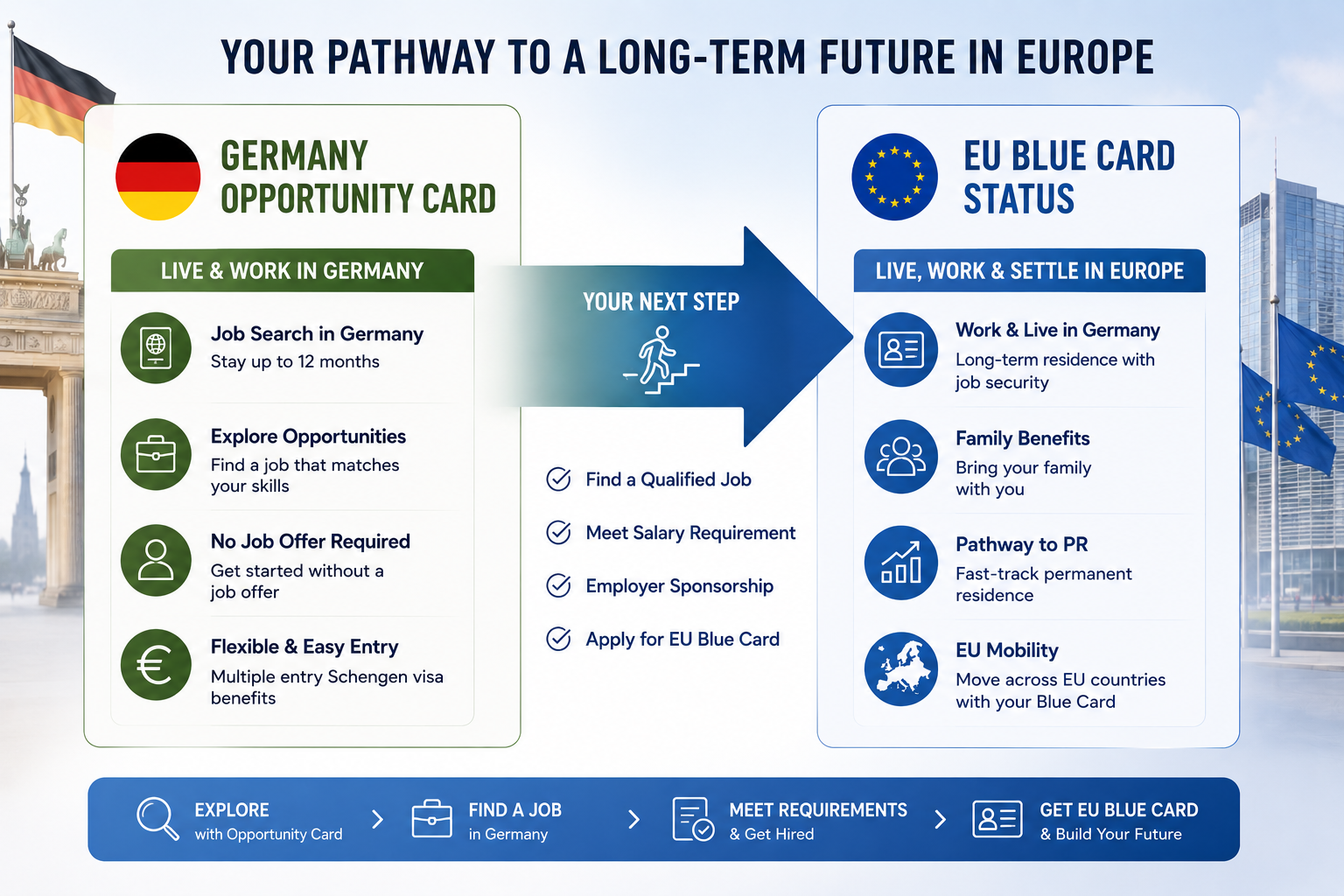
If you are planning to move to Germany for work, understanding how your visa status evolves is essential. Many skilled workers start their journey with the Germany Opportunity Card and later transition to the EU Blue Card. These are two distinct visa categories with different purposes, rights, and timelines.
Overview
The Opportunity Card (Chancenkarte) is a job-seeker visa that allows skilled workers to enter Germany and search for employment. It is not a work permit. Once you secure qualifying employment, you can transition to a more permanent status such as the EU Blue Card, which is designed for highly qualified professionals.
This transition is a structured legal pathway, not an automatic upgrade. It requires meeting specific conditions and submitting a formal application.
Key Eligibility Requirements
Each visa stage has its own eligibility criteria. Here is what you need to qualify for both.
For the Opportunity Card:
- Recognised foreign qualification or a German or recognised university degree
- Sufficient financial resources to support yourself during your job search
- Basic German language skills or other qualifying criteria under the points-based system
- No prior rejection of a German visa without a significant change in circumstances
For the EU Blue Card:
- A recognised university degree or comparable higher education qualification
- A concrete, binding job offer or employment contract in Germany
- A salary that meets the statutory minimum threshold set for Blue Card holders
- The job must be relevant to your qualification
Application Process
The transition from an Opportunity Card to an EU Blue Card follows a logical sequence. Here are the steps involved.
- Enter Germany on the Opportunity Card and begin your authorised job search period.
- Secure a qualifying job offer that meets the salary and qualification requirements for the EU Blue Card.
- Book an appointment at the local Foreigners Authority (Auslnderbehrde) in your area.
- Submit your application for the EU Blue Card before your Opportunity Card expires.
- Await a decision from the immigration authority. You may receive a provisional confirmation allowing you to start work in some cases.
- Collect your EU Blue Card once approved and begin your employment officially.
Required Documents
Prepare the following documents before applying for the EU Blue Card transition.
- Valid passport with sufficient validity
- Current Opportunity Card or residence permit
- Signed employment contract or binding job offer letter
- Recognised university degree or official credential evaluation
- Proof of accommodation in Germany
- Recent biometric passport photographs
- Completed application form from the Foreigners Authority
- Health insurance proof valid in Germany
Document requirements can vary by state and individual office. Always confirm with your local Auslnderbehrde before your appointment.
Benefits and Limitations
Benefits
- The EU Blue Card offers a clear path to permanent residency after a qualifying period
- Blue Card holders can bring family members to Germany under favourable conditions
- The card is recognised across most EU member states, offering future mobility options
- Holders can change employers, subject to certain notification requirements
- The Opportunity Card allows you to legally enter and explore the German job market before committing
Limitations
- The Opportunity Card does not permit full-time employment in your qualified profession
- There is a fixed validity period on the Opportunity Card with no guarantee of extension
- The EU Blue Card requires a salary threshold that not all job offers may meet
- Your degree must be officially recognised in Germany, which can take time to arrange
- Transitioning statuses requires a formal application and is not processed instantly
Common Mistakes to Avoid
- Waiting too long to apply: Do not wait until your Opportunity Card is about to expire before submitting your Blue Card application.
- Accepting a job below the salary threshold: Verify that the offered salary qualifies for the EU Blue Card before signing a contract.
- Unrecognised qualifications: Begin the credential recognition process early, ideally before arriving in Germany.
- Missing documentation: Incomplete applications cause delays and can jeopardise your legal stay.
- Not registering your address: You must register (Anmeldung) at your German address before attending the Foreigners Authority appointment.
- Working beyond permitted limits on the Opportunity Card: This can affect your future visa applications negatively.
Frequently Asked Questions
Can I work in Germany while holding an Opportunity Card?
The Opportunity Card allows limited work, generally up to a certain number of hours per week in unqualified positions. It does not permit full-time skilled employment in your profession. Always check the specific conditions stated on your card.
How long can I stay in Germany on the Opportunity Card before transitioning?
The Opportunity Card is typically issued for a defined period. You should aim to secure employment and apply for your EU Blue Card well before this period ends to avoid any gap in your legal status.
Does my foreign degree automatically qualify me for the EU Blue Card?
Not necessarily. Your degree must be officially recognised in Germany or assessed as equivalent. You can check recognition options through the German Recognition Portal (Anerkennung in Deutschland). Starting this process early is strongly recommended.
Can my family join me during the Opportunity Card stage?
Family reunification is generally associated with more settled visa statuses such as the EU Blue Card. During the Opportunity Card stage, family joining options are more limited. Once you hold a Blue Card, your spouse and dependent children can apply to join you under more favourable conditions.
What happens if my Opportunity Card expires before I receive the Blue Card decision?
If you have submitted a timely and complete application for the EU Blue Card before your Opportunity Card expires, you may receive a temporary confirmation (Fiktionsbescheinigung) that allows you to remain legally in Germany while the application is processed. Speak with an immigration consultant to handle this carefully.
How Visas Avenue Can Help
Navigating the transition from an Opportunity Card to an EU Blue Card involves precise timing, documentation, and compliance with German immigration law. Visas Avenue provides end-to-end guidance for skilled workers at every stage of this process, from credential assessment and application preparation to appointment support and status monitoring. Our experienced advisors ensure your application is complete, compliant, and submitted on time.
Conclusion
The pathway from the Opportunity Card to the EU Blue Card is a well-defined route for qualified professionals seeking a long-term future in Germany. With the right preparation and timely action, you can move through each visa stage confidently. Start your planning early, keep your documents in order, and seek professional guidance to avoid costly errors.






Anusha V. Ramani
A group of diligent team members I must say! Very prompt and thorough in their job. Would...

Varun Thomas
Got our Canada PR done and I must say they are really professionals and they know what...

Vinay Upadhaya
Co-operative and Trained Staff to handhold you throughout the process. Mr.Vinay Upadhyay

Runzhun Gangrade
Great service and good support from the entire team. We had a great experience working...

Aakanksha Singh Chauhan
Thank you so much for your help Mrigya & Arpita. You keen sense of dedication to my...

Sanjeev Sharma
Very Professional Consultancy, which has actual meaningful escalation Matrix system for...