
One Profile, Three Countries: Free Comparison Across Australia, Canada, and Germany
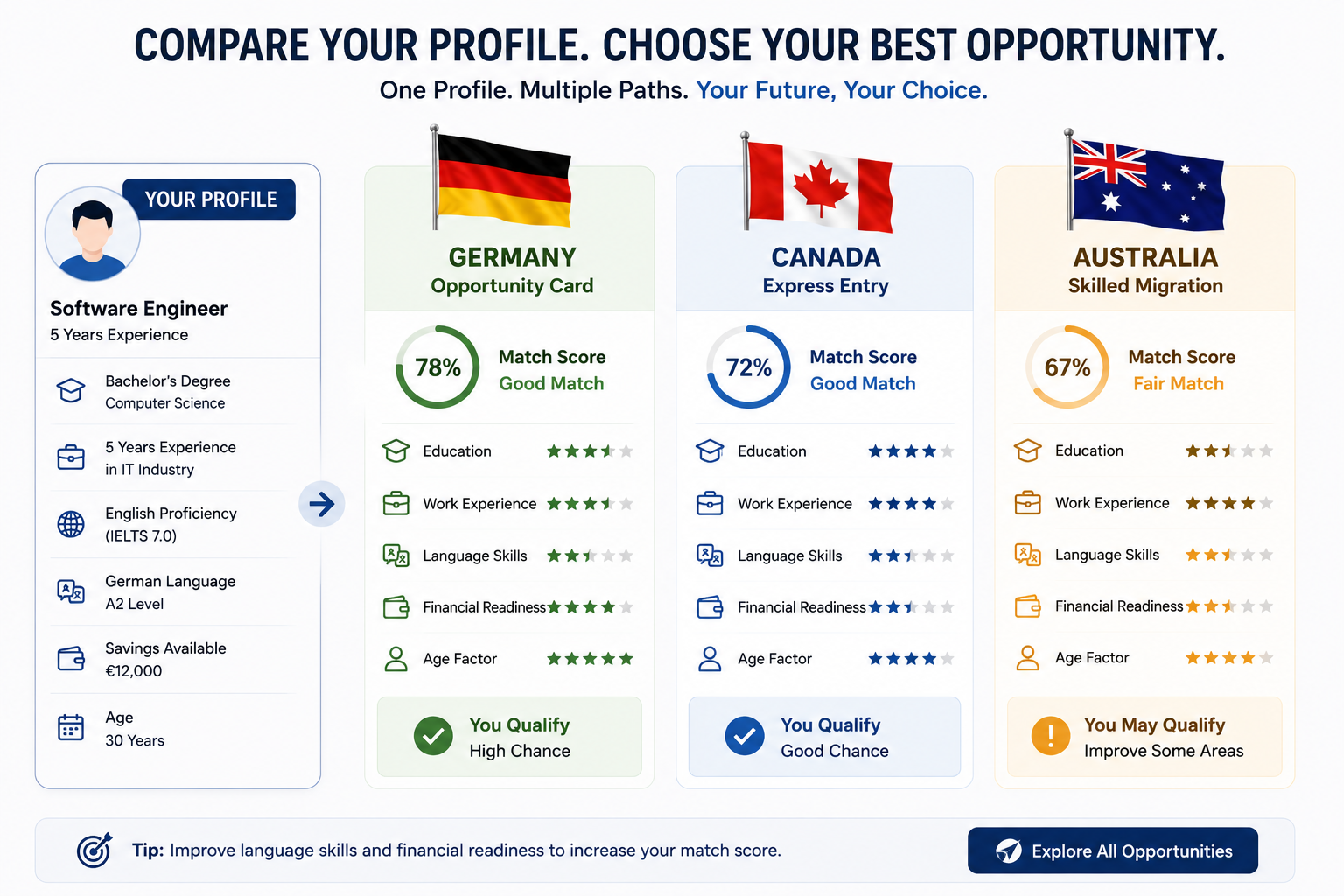
If you are a skilled professional exploring immigration options abroad, you may qualify for more than one country at the same time. Australia, Canada, and Germany each offer structured pathways for skilled migrants but they differ significantly in eligibility criteria, processing systems, and long-term outcomes. This comparison uses a single professional profile to show how the same person might fare across all three destinations.
Overview
Each country uses a distinct immigration model. Canada relies on an expression-of-interest pool with regular draws. Australia uses a points-tested system with state-based nominations. Germany focuses on recognized qualifications and a confirmed job offer or job-seeker visa route.
Understanding how your profile maps to each system helps you prioritize where to apply and when.
Sample Profile Used for This Comparison
To keep this practical, we use the following hypothetical profile throughout the article:
- Age: 32 years
- Education: Bachelor's degree in Information Technology
- Work Experience: 6 years in software development
- English Proficiency: IELTS 7.5 overall
- Marital Status: Married, spouse with moderate English skills
- No prior immigration violations or criminal record
Key Eligibility Requirements
Australia
- Occupation must appear on a relevant skilled occupation list
- Skills assessment from the designated assessing authority (e.g., ACS for IT)
- Minimum points score required to receive an invitation
- English language proficiency is mandatory
- Age generally must be under 45 at time of invitation
Canada
- Eligible under Express Entry through Federal Skilled Worker, CEC, or FSTP streams
- Educational Credential Assessment (ECA) required for foreign degrees
- Language test results in English or French are mandatory
- Work experience must meet NOC classification requirements
- Provincial Nominee Programs can boost ranking significantly
Germany
- Degree or qualification must be recognized by German authorities
- Job offer from a German employer is typically required for skilled worker visa
- Job Seeker Visa allows entry to search for work if qualifications meet standards
- Basic German language skills are advantageous, though not always mandatory for IT roles
- Salary must meet minimum thresholds set by German immigration law
Application Process
Australia Subclass 189 or 190
- Get a skills assessment from the relevant authority
- Submit an Expression of Interest (EOI) through SkillSelect
- Receive an invitation to apply based on points ranking
- Lodge a visa application with supporting documents
- Await health checks, police clearances, and decision
Canada Express Entry
- Complete a language test and obtain ECA if required
- Create an Express Entry profile online
- Enter the pool and receive a Comprehensive Ranking System (CRS) score
- Wait for an Invitation to Apply (ITA) through a draw
- Submit full application within 60 days of receiving ITA
Germany Skilled Worker Visa
- Get qualifications assessed by the relevant German authority
- Secure a job offer from a German employer
- Apply for a national visa at the German embassy in your home country
- Travel to Germany and apply for a residence permit
- Register your address and complete remaining formalities on arrival
Required Documents
- Valid passport with sufficient validity
- Educational certificates and transcripts
- Skills assessment or qualification recognition letter
- Language test results (IELTS, PTE, CELPIP, Goethe, or TestDaF as applicable)
- Employment reference letters detailing role, duties, and duration
- Police clearance certificates from all countries of residence
- Medical examination results from approved physicians
- Proof of funds (where required)
- Job offer letter (mandatory for Germany, beneficial for Canada and Australia)
Benefits and Limitations
Benefits
- Australia: High quality of life, strong IT job market, pathway to permanent residency and citizenship
- Canada: Fast PR pathway, multicultural environment, family-friendly immigration policy
- Germany: Access to the EU, strong engineering and tech sector, stable economy
- All three countries offer pathways to permanent residency and eventual citizenship
- Dependants can generally accompany the primary applicant
Limitations
- Australia: Invitation-based system means wait times can vary; points competition is high
- Canada: CRS score requirements fluctuate with each draw; uncertainty in invitation timelines
- Germany: Qualification recognition process can be lengthy; language may be a barrier in non-tech roles
- All three require careful document preparation and can involve significant costs
Common Mistakes to Avoid
- Submitting an EOI or Express Entry profile before completing your skills assessment or ECA
- Underestimating the time required for qualification recognition in Germany
- Using incorrect NOC or ANZSCO codes that do not match your actual job duties
- Providing employment reference letters that lack specific role descriptions
- Ignoring spouse or partner profile improvements that could add to overall points
- Missing document expiry dates, especially for language tests and medicals
- Applying without professional guidance when your profile has gaps or complexities
Frequently Asked Questions
Can I apply to all three countries simultaneously?
Yes, there is no rule preventing you from pursuing multiple immigration pathways at the same time. Many skilled professionals submit profiles or applications to two or three countries in parallel to improve their chances of a successful outcome.
Which country is easiest to immigrate to for an IT professional?
Ease depends on your specific profile. IT professionals generally score well across all three systems. Canada and Australia reward points-based profiles, while Germany values recognized qualifications and a confirmed job offer. A consultant can assess which route suits your profile best.
Does my spouse's profile affect my application?
In Canada and Australia, your spouse's language scores, education, and work experience can add points to your combined profile. In Germany, your spouse can typically accompany you on a dependent visa and may be permitted to work.
How long does permanent residency take in each country?
Timelines vary based on stream, volume of applications, and government processing capacity. Generally, Canada's Express Entry is known for relatively faster PR processing after an ITA. Australia and Germany also offer PR pathways, but specific timelines depend on individual circumstances.
Is a job offer required to immigrate to these countries?
A job offer is generally required for Germany's skilled worker visa. In Canada, a valid job offer can increase your CRS score but is not mandatory for Express Entry. In Australia, a job offer is not required for points-tested visas but can support state nomination applications.
How Visas Avenue Can Help
Visas Avenue offers a free profile assessment that evaluates your eligibility across multiple destinations simultaneously. Our immigration experts review your education, work experience, language scores, and personal circumstances to identify your strongest pathway whether that is Australia, Canada, Germany, or a combination approach.
Reach out to our team for a no-obligation consultation and get a clear picture of your options before you invest time or money in applications.
Conclusion
A single strong profile can open doors to three different countries. Australia, Canada, and Germany each offer genuine opportunities for skilled professionals the key is knowing where your profile fits best. Use this comparison as a starting point, get a professional assessment, and take your next step with confidence.
.png)



Anusha V. Ramani
A group of diligent team members I must say! Very prompt and thorough in their job. Would...

Varun Thomas
Got our Canada PR done and I must say they are really professionals and they know what...

Vinay Upadhaya
Co-operative and Trained Staff to handhold you throughout the process. Mr.Vinay Upadhyay

Runzhun Gangrade
Great service and good support from the entire team. We had a great experience working...

Aakanksha Singh Chauhan
Thank you so much for your help Mrigya & Arpita. You keen sense of dedication to my...

Sanjeev Sharma
Very Professional Consultancy, which has actual meaningful escalation Matrix system for...