
Germany vs Canada vs Australia: Which No-Job-Offer PR Pathway Is Fastest in 2026
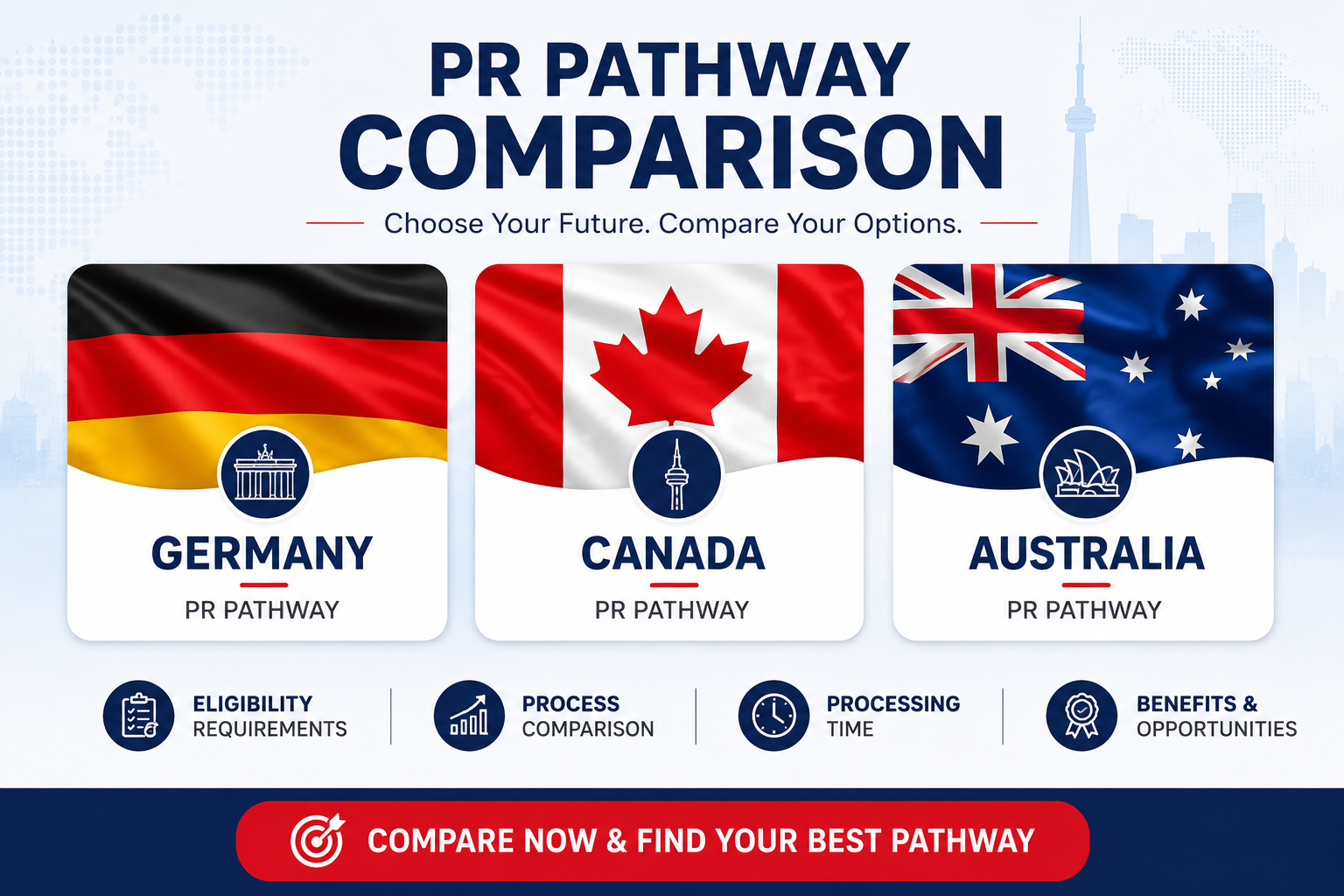
If you are planning to immigrate in 2026 without a job offer, three countries stand out as leading destinations: Germany, Canada, and Australia. Each offers a points-based or structured pathway that does not require employer sponsorship. But which one gets you to Permanent Residency fastest?
This comparison breaks down the key differences so you can make an informed decision based on your profile, qualifications, and timeline.
Overview
All three countries allow skilled professionals to apply for PR without a prior job offer. However, the route, timeline, and eligibility criteria vary significantly.
| Country | Primary Pathway | Typical Processing Time | Job Offer Required |
|---|---|---|---|
| Canada | Express Entry (Federal Skilled Worker) | 6 months or less (for ITA holders) | No |
| Australia | Skilled Independent Visa (Subclass 189) | Several months to over a year | No |
| Germany | EU Blue Card / Skilled Immigration Act | Varies by state and consulate | Depends on pathway |
Canada's Express Entry system is widely considered the fastest structured route for no-job-offer PR among the three, though individual outcomes depend on CRS scores and draw frequency.
Key Eligibility Requirements
Canada Express Entry (Federal Skilled Worker)
- Minimum one year of skilled work experience in an eligible NOC occupation
- Language proficiency in English or French (IELTS or TEF)
- Educational credential assessment (ECA) for foreign degrees
- Meeting minimum CRS score requirements in competitive draws
- No Canadian job offer required to enter the pool
Australia Subclass 189 Skilled Independent
- Occupation must appear on the relevant skilled occupation list
- Skills assessment from the relevant assessing authority
- Minimum points score (currently 65 points on the points test)
- Age generally under 45 at time of invitation
- Competent English language ability required
Germany Skilled Immigration Act Pathway
- Recognised foreign qualification equivalent to a German degree or vocational qualification
- Basic German language skills are often beneficial but not always mandatory
- Proof of financial means to support yourself during the job search period
- The Opportunity Card (Chancenkarte) allows entry to search for a job, not immediate PR
- PR through this route typically follows after employment and residence period
Application Process
Canada Express Entry
- Check eligibility under the Federal Skilled Worker Program or Canadian Experience Class
- Gather language test results, ECA, and work experience documents
- Create an Express Entry profile and receive a CRS score
- Wait for an Invitation to Apply (ITA) in a draw
- Submit a complete PR application within 60 days of receiving the ITA
- Receive a decision, typically within six months of a complete application
Australia Subclass 189
- Get your skills assessed by the relevant Australian assessing body
- Submit an Expression of Interest (EOI) through SkillSelect
- Receive an invitation to apply based on your points score
- Lodge the visa application with supporting documents
- Await processing, which can vary depending on occupation and application volume
Germany Opportunity Card or Blue Card Route
- Have your foreign qualification recognised or assessed by German authorities
- Apply for the Opportunity Card visa to enter Germany for job search
- Secure employment in your qualified field within the permitted stay
- Convert to a residence permit and work toward permanent settlement after required years
Required Documents
- Valid passport with sufficient validity
- Language test results (IELTS, TEF, PTE, or German language certificates)
- Educational certificates and transcripts with certified translations
- Educational Credential Assessment or skills assessment report
- Work experience letters and employment records
- Proof of funds (required for Australia and Germany)
- Police clearance certificates
- Medical examination results (varies by country and stage)
Benefits and Limitations
Benefits
- Canada: Fastest processing among the three once an ITA is received; no job offer needed; straightforward online process
- Australia: Permanent residency granted directly; no employer dependency; strong post-PR work rights
- Germany: Gateway to Europe; access to EU Blue Card benefits; strong economy with high demand for skilled workers
- All three countries offer pathways to citizenship after meeting residency requirements
- Family members can typically be included in the application
Limitations
- Canada: CRS score competition can be high; draws are not guaranteed; lower-scoring profiles may wait longer
- Australia: Skills assessment process can be lengthy; occupation lists are regularly updated and can be restrictive
- Germany: The Opportunity Card does not directly grant PR; language barriers can affect settlement; recognition of foreign qualifications can be complex
- Processing times for all three countries can change based on application volumes and policy shifts
Common Mistakes to Avoid
- Submitting an Express Entry profile with an incorrect NOC code for your occupation
- Not renewing language test scores before they expire during a long wait in the pool
- Failing to get a proper skills assessment before lodging an EOI for Australia's Subclass 189
- Assuming the German Opportunity Card leads directly to PR without planning the employment step
- Ignoring the age factor, especially for Australia's points test where age impacts your score
- Providing incomplete or inconsistent work experience documentation
- Not using a registered immigration professional when the process becomes complex
Frequently Asked Questions
Which country gives PR fastest without a job offer in 2026?
Canada's Express Entry is generally the fastest route once you receive an Invitation to Apply, with processing often completed within six months. However, receiving an ITA depends on your CRS score and the frequency of draws in your category.
Can I apply for Australian PR without a job offer?
Yes. The Subclass 189 Skilled Independent visa does not require a job offer or state sponsorship. You need a valid skills assessment, meet the points threshold, and receive an invitation through SkillSelect.
Does Germany offer direct PR without a job offer?
Germany's Opportunity Card allows you to enter Germany to search for employment, but it is not a direct PR pathway. Permanent residency in Germany generally requires a period of qualified employment and lawful residence before you can apply.
Is a language test mandatory for all three countries?
Yes, in different forms. Canada requires IELTS or equivalent for English or French. Australia requires proof of competent English through recognised tests. Germany increasingly values German language ability, though some roles and Blue Card applicants may have more flexibility depending on the pathway.
Can my family migrate with me on these pathways?
Yes. All three countries allow primary applicants to include dependent family members such as spouses and children in their applications. Family members generally receive the same residency rights as the primary applicant upon approval.
How Visas Avenue Can Help
Choosing the right immigration pathway is one of the most important decisions you will make. At Visas Avenue, our experienced immigration consultants assess your profile across multiple destinations and recommend the fastest and most suitable route for your specific qualifications, work history, and goals. We handle documentation, submissions, and follow-ups so you avoid costly mistakes and delays.
Conclusion
For most skilled professionals in 2026, Canada's Express Entry offers the fastest route to PR without a job offer, provided your CRS score is competitive. Australia's Subclass 189 is a strong alternative for those with an in-demand occupation and a solid points score. Germany is ideal if you are open to a staged approach and want access to Europe. Evaluate your profile carefully and consult a qualified immigration advisor before committing to a pathway.



.png)

Anusha V. Ramani
A group of diligent team members I must say! Very prompt and thorough in their job. Would...

Varun Thomas
Got our Canada PR done and I must say they are really professionals and they know what...

Vinay Upadhaya
Co-operative and Trained Staff to handhold you throughout the process. Mr.Vinay Upadhyay

Runzhun Gangrade
Great service and good support from the entire team. We had a great experience working...

Aakanksha Singh Chauhan
Thank you so much for your help Mrigya & Arpita. You keen sense of dedication to my...

Sanjeev Sharma
Very Professional Consultancy, which has actual meaningful escalation Matrix system for...