
Canada Super Visa vs Visitor Visa: Which One Is Right for Parents and Grandparents?
For families living in Canada, visiting parents and grandparents is an important part of staying connected. Whether it is spending time with grandchildren, attending a family celebration or simply enjoying an extended family visit, choosing the right Canadian visa can make the travel process easier to plan.
Two options often considered by families are the Canada Visitor Visa and the Super Visa.
Although both are temporary visa options, they are not designed for exactly the same purpose. Understanding the difference can help applicants decide which option better matches their travel plans.
What Is a Canada Visitor Visa?
A Canada Visitor Visa, also called a Temporary Resident Visa (TRV), allows eligible foreign nationals to travel to Canada for temporary purposes such as tourism, visiting family or friends and other permitted activities.
Most visitors are normally allowed to stay in Canada for up to six months, although the final period of stay is determined by the Canadian border services officer when the visitor arrives.
A Visitor Visa may therefore be suitable for parents or grandparents who want to visit their family in Canada for a relatively short period.
However, having a visa does not automatically mean that a visitor can remain in Canada until the visa's expiry date. The visa generally indicates the period during which the person can travel to Canada; the authorized length of stay is determined separately at entry.
What Is a Canada Super Visa?
The Super Visa is a temporary visa option specifically designed for eligible parents and grandparents of Canadian citizens, permanent residents or registered Indians.
Its major advantage is the possibility of a significantly longer stay.
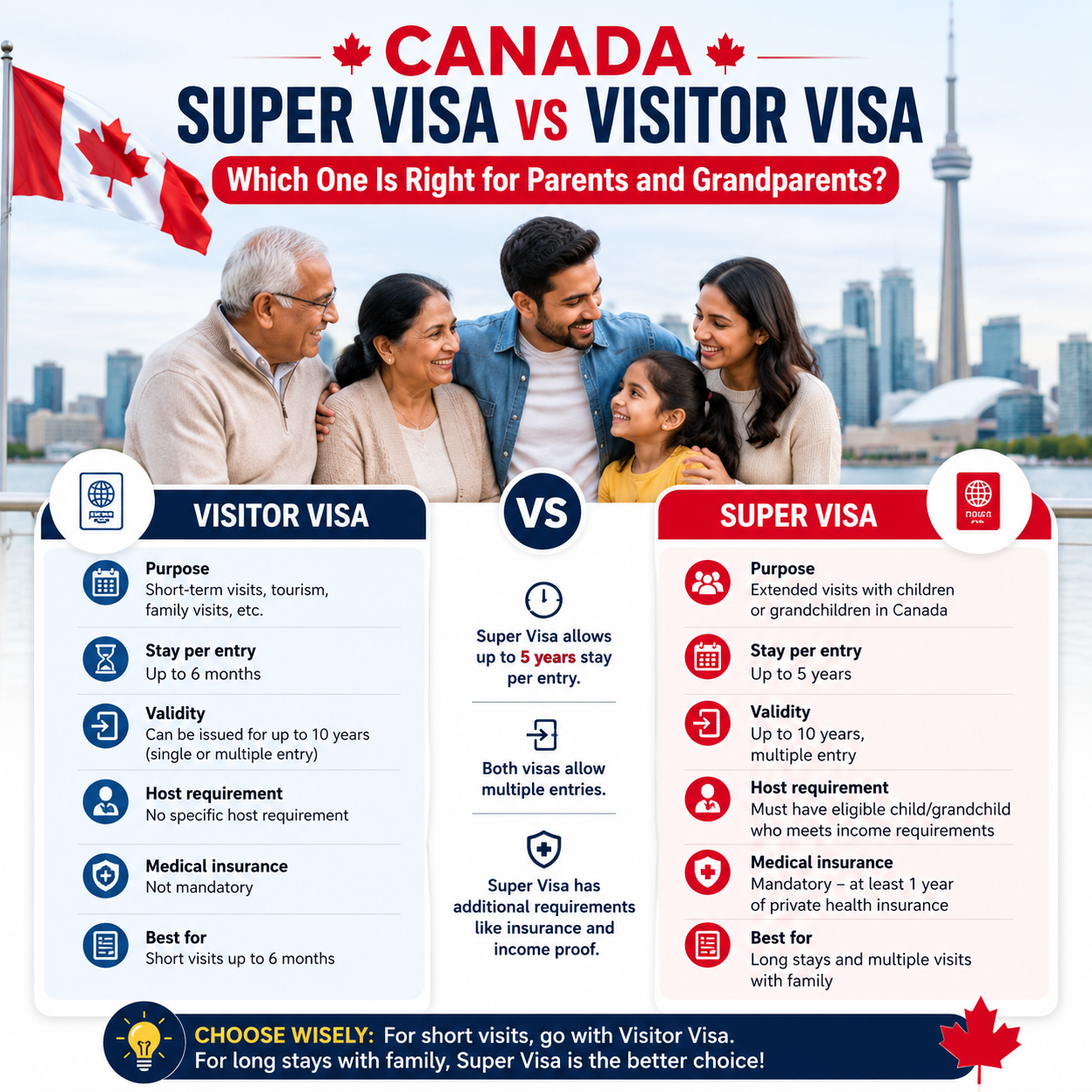
Eligible Super Visa holders can stay in Canada for up to five years at a time, and the visa can provide multiple entries for a period of up to 10 years.
For parents and grandparents who want to spend an extended period with their family in Canada, this can make the Super Visa an attractive alternative to a regular Visitor Visa.
Super Visa vs Visitor Visa: The Main Difference
The most important difference is the purpose and circumstances of the applicant.
A Visitor Visa is a general temporary visitor option. A Super Visa is specifically designed for eligible parents and grandparents who want to visit their family in Canada for an extended period.
Visitor Visa may be suitable when:
-
The planned visit is relatively short.
-
The applicant wants to visit children, relatives or friends.
-
The applicant wants to travel around Canada as a tourist.
-
The applicant intends to return to their home country after the visit.
Super Visa may be suitable when:
-
The applicant is an eligible parent or grandparent.
-
Their child or grandchild is a Canadian citizen, permanent resident or registered Indian.
-
They want to spend an extended period with their family in Canada.
-
They can meet the additional Super Visa requirements.
Why Is the Super Visa More Demanding?
The Super Visa provides the possibility of a much longer stay, so applicants must meet additional requirements.
Depending on the circumstances, the application includes requirements relating to:
-
The relationship between the applicant and the Canadian host.
-
A formal invitation from the child or grandchild in Canada.
-
The host's ability to meet the applicable financial requirement.
-
An immigration medical examination.
-
Appropriate private medical insurance.
-
Evidence that the applicant meets Canada's temporary resident requirements.
The applicant must also satisfy the immigration officer that they are a genuine temporary resident and will comply with the conditions of their stay.
Medical Insurance for a Super Visa
Medical insurance is one of the important differences families need to consider when planning a Super Visa application.
Super Visa applicants are required to have qualifying private health insurance that meets Canada's requirements, including at least CAD $100,000 in emergency medical coverage and coverage for applicable healthcare, hospitalization and repatriation expenses.
This means families should consider the cost and validity of the insurance policy when planning their application.
What About the Financial Requirement?
For a Super Visa, the child or grandchild in Canada must generally demonstrate that they meet the applicable minimum necessary income requirement.
The host provides financial documentation to demonstrate their ability to support the visiting parent or grandparent.
Financial documentation should be consistent and clearly demonstrate the family's ability to support the proposed visit.
Applicants should always check the latest IRCC requirements before submitting an application because financial thresholds and program requirements can change.
Which Visa Should Parents or Grandparents Choose?
There is no single visa that is automatically better for every applicant.
The right option depends on the applicant's circumstances and the genuine purpose of the visit.
For example, if parents are planning to visit Canada for two or three months to spend time with their children and grandchildren, a Visitor Visa may be appropriate.
On the other hand, if eligible parents or grandparents want to spend a much longer period with their family in Canada, the Super Visa may be worth considering.
The decision should therefore be based on the intended duration of the visit, family relationship, financial circumstances and eligibility requirements.
A Strong Application Is About More Than Documents
One common mistake applicants make is focusing only on the number of documents they can submit.
For a temporary visa application, the overall story should make sense.
The application should clearly explain:
Who is travelling?
Why are they travelling to Canada?
Who will they visit?
Who will pay for the trip?
Where will they stay?
How long do they intend to remain in Canada?
What circumstances demonstrate their temporary purpose?
The supporting documents should reinforce the information provided in the application rather than create contradictions.
For example, financial records, travel plans, family information and the proposed length of stay should all present a consistent picture of the applicant's circumstances.
Super Visa Does Not Mean Permanent Residence
Another important point is that the Super Visa is a temporary residence option.
It does not provide permanent resident status and does not automatically lead to Canadian citizenship.
Its purpose is to allow eligible parents and grandparents to spend extended periods with their families in Canada while remaining temporary residents.
Families considering permanent residence should separately assess the immigration programs that may be available to them.
Visitor Visa or Super Visa – A Simple Comparison
| Feature | Visitor Visa | Super Visa |
|---|---|---|
| Main purpose | Temporary visit or tourism | Extended visits by eligible parents and grandparents |
| Eligible applicants | General eligible visitors | Eligible parents and grandparents |
| Typical stay | Usually up to 6 months | Up to 5 years at a time |
| Multiple entries | May be available | Available |
| Visa validity | Can be issued for up to 10 years, subject to circumstances | Up to 10 years |
| Host financial requirement | No Super Visa-specific income test | Applicable income requirement for host |
| Medical insurance | Not a specific Visitor Visa requirement | Required |
| Medical examination | Depends on circumstances | Required |
| Permanent residence | No | No |
Most visitors can normally stay for up to six months, while eligible Super Visa holders entering under the current rules can stay for up to five years at a time.
Final Thoughts
For parents and grandparents planning to visit Canada, choosing between a Visitor Visa and Super Visa should start with one simple question:
What is the genuine purpose and expected duration of the visit?
A Visitor Visa can be a practical option for a shorter family visit or holiday. For eligible parents and grandparents who want to spend substantially more time with their family in Canada, the Super Visa may offer a more suitable temporary option.
At Visas Avenue, we understand that every family's circumstances are different. Our team can help applicants understand the available visa options, assess their circumstances and prepare their application and supporting documentation appropriately.
If you are planning to visit your children or grandchildren in Canada and are unsure whether a Visitor Visa or Super Visa is more suitable, getting the right guidance before applying can help you make a more informed decision.
Visas Avenue – Helping Families Navigate Their Canada Visa Journey.
Immigration requirements and procedures can change. Applicants should always review the latest official IRCC requirements before submitting an application.

.png)



Anusha V. Ramani
A group of diligent team members I must say! Very prompt and thorough in their job. Would...

Varun Thomas
Got our Canada PR done and I must say they are really professionals and they know what...

Vinay Upadhaya
Co-operative and Trained Staff to handhold you throughout the process. Mr.Vinay Upadhyay

Runzhun Gangrade
Great service and good support from the entire team. We had a great experience working...

Aakanksha Singh Chauhan
Thank you so much for your help Mrigya & Arpita. You keen sense of dedication to my...

Sanjeev Sharma
Very Professional Consultancy, which has actual meaningful escalation Matrix system for...