
Canada PR Document Checklist 2026: Everything You Need Ready
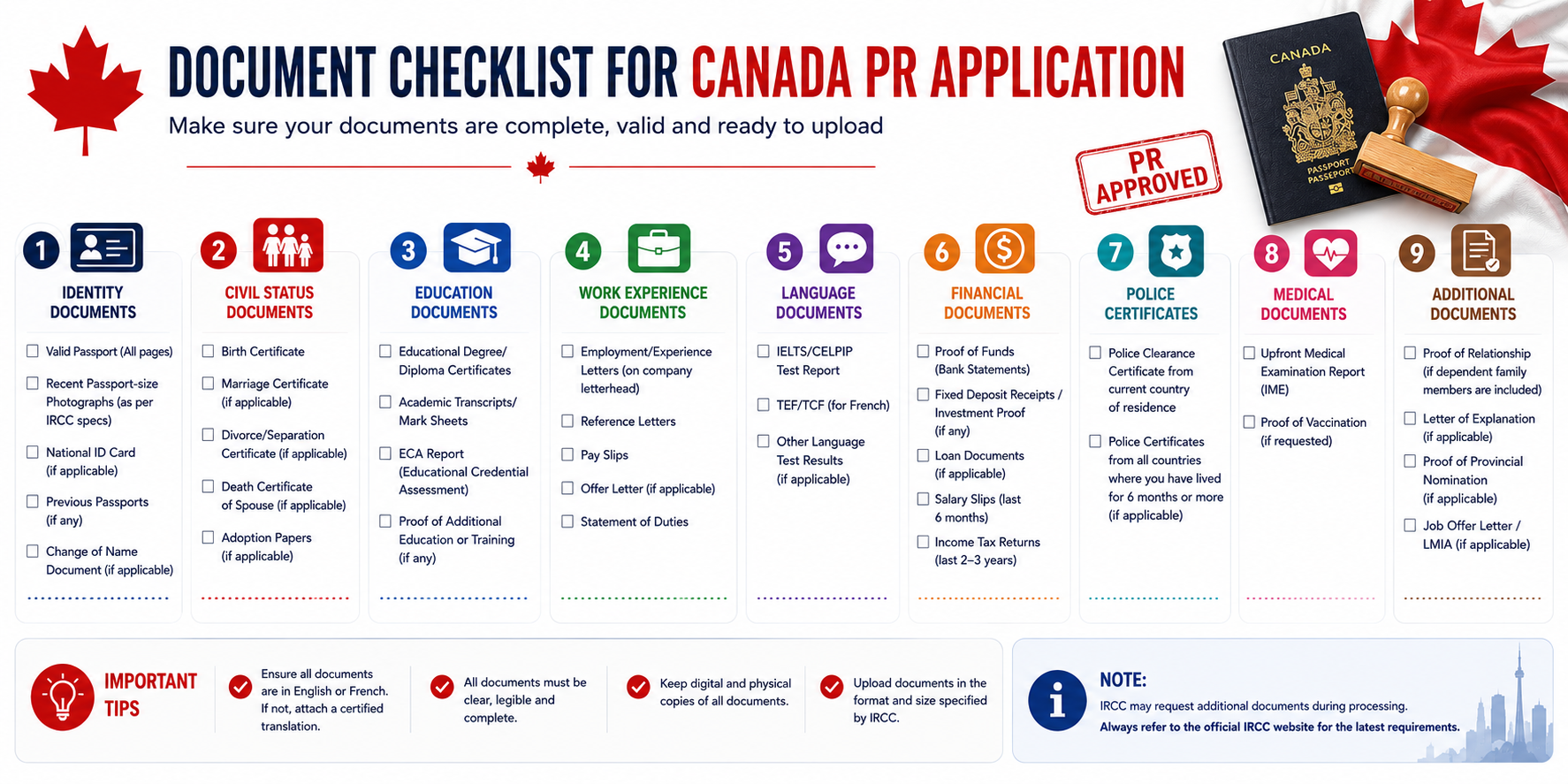
Missing even one document can delay your Canada PR application by months. This checklist covers everything you need to gather before submitting your permanent residency application whether you are applying through Express Entry, a Provincial Nominee Program, or another pathway.
Overview
Canada's permanent residency process requires applicants to submit a comprehensive set of personal, professional, and legal documents. The exact list varies depending on your immigration pathway, but a core set of documents applies to almost every PR application.
Getting your documents right the first time saves you time, money, and stress.
Key Eligibility Requirements
Before assembling your documents, confirm you meet the basic eligibility criteria for your chosen PR pathway.
- Valid work experience: Typically at least one year of skilled work experience in an eligible occupation
- Language proficiency: A valid IELTS, CELPIP, or TEF score meeting minimum thresholds
- Educational qualifications: A completed degree, diploma, or credential foreign credentials may require an Educational Credential Assessment (ECA)
- Proof of funds: Sufficient settlement funds unless you have a valid Canadian job offer
- Admissibility: No serious criminal history or medical conditions that could make you inadmissible
Application Process
Understanding the general steps helps you know which documents are needed at each stage.
- Determine your pathway: Express Entry, PNP, Family Sponsorship, or another route
- Create or update your online profile: Submit your expression of interest or application on the IRCC portal
- Receive an Invitation to Apply (ITA): Applicable for Express Entry candidates
- Gather all required documents: Use this checklist to prepare your complete document package
- Submit your application: Upload all documents accurately before the deadline
- Attend biometrics appointment: If required for your application
- Complete medical examination: With an IRCC-approved panel physician
- Receive a decision: IRCC will issue a Confirmation of Permanent Residence (COPR) if approved
Required Documents
The following documents are required for most Canada PR applications. Always verify the current list on the official IRCC website before submitting.
- Valid passport: Must be valid for the full duration of your application process
- Travel history: Details of all countries visited in the past ten years
- Identity documents: National ID card, birth certificate
- Passport-size photographs: Meeting IRCC's photo specifications
- Language test results: IELTS, CELPIP, TEF, or TCF must be within validity period
- Educational Credential Assessment (ECA): Required if your credentials are from outside Canada
- Educational certificates and transcripts: All degrees and diplomas you are claiming points for
- Proof of work experience: Employment letters, pay stubs, tax records, and job offer letters
- Reference letters from employers: On company letterhead with contact details
- Proof of settlement funds: Bank statements for the last three to six months
- Police clearance certificates: From each country where you lived for six months or more since age 18
- Medical examination results: Completed by an approved panel physician
- Marriage certificate or divorce decree: If applicable
- Birth certificates for dependent children: If including family members
- Provincial nomination certificate: If applying through a PNP stream
- Canadian job offer letter: If claiming additional points or exemption from settlement funds
Benefits and Limitations
Benefits
- Permanent residency grants the right to live and work anywhere in Canada
- Access to publicly funded healthcare and social services
- Pathway to Canadian citizenship after meeting residency obligations
- Ability to sponsor eligible family members for PR
- Protection under Canadian law and the Canadian Charter of Rights and Freedoms
Limitations
- Document collection can be time-consuming, especially for police clearance certificates from multiple countries
- ECAs from designated organizations can take several weeks
- Language tests must be re-taken if scores expire before a decision is made
- Incomplete or incorrect documents result in application delays or refusals
- Settlement fund requirements must be maintained until a decision is issued
Common Mistakes to Avoid
- Submitting expired documents: Language scores, medical reports, and police certificates all have validity periods
- Incorrect photo specifications: Photos not meeting IRCC guidelines are a frequent reason for rejection
- Missing employment reference letters: A job offer letter alone is not sufficient you need detailed employer reference letters
- Incomplete travel history: Gaps or inaccuracies in your travel records can raise concerns
- Not getting ECA done in advance: ECA processing takes time and must be completed before submitting your profile
- Using unofficial translators: All non-English or non-French documents must be translated by a certified translator
- Underestimating settlement funds required: The amount required increases with the number of family members included
Frequently Asked Questions
How early should I start collecting documents for my Canada PR application?
Start at least three to six months before you plan to submit. Police clearance certificates and ECAs can take the longest, so initiate those first.
Do I need an ECA if I studied in Canada?
No. If your degree, diploma, or certificate is from a Canadian institution, an Educational Credential Assessment is generally not required.
How long are language test scores valid for Canada PR?
Most language test scores, including IELTS and CELPIP, are valid for two years from the test date. Always confirm current validity requirements on the IRCC website.
Can I submit my application if one document is missing?
It is strongly advised not to submit an incomplete application. Missing documents typically result in requests for additional information, delays, or outright refusal of your application.
Do dependent children need separate police clearance certificates?
Police clearance certificates are generally required for applicants aged 18 and above. Check the specific requirements for your pathway on the IRCC website, as rules can vary.
How Visas Avenue Can Help
Visas Avenue's immigration experts provide end-to-end support for your Canada PR application from assessing your eligibility and identifying the right pathway to reviewing every document before submission.
Our team helps you avoid costly errors, stay updated on IRCC requirements, and submit a complete, accurate application the first time.
Conclusion
A well-prepared document package is the foundation of a successful Canada PR application. Use this checklist as your starting point, verify requirements on the official IRCC website, and consider professional guidance to navigate the process with confidence.




Anusha V. Ramani
A group of diligent team members I must say! Very prompt and thorough in their job. Would...

Varun Thomas
Got our Canada PR done and I must say they are really professionals and they know what...

Vinay Upadhaya
Co-operative and Trained Staff to handhold you throughout the process. Mr.Vinay Upadhyay

Runzhun Gangrade
Great service and good support from the entire team. We had a great experience working...

Aakanksha Singh Chauhan
Thank you so much for your help Mrigya & Arpita. You keen sense of dedication to my...

Sanjeev Sharma
Very Professional Consultancy, which has actual meaningful escalation Matrix system for...