
Savings Required for PR Without a Job Offer: Australia vs Canada vs Germany
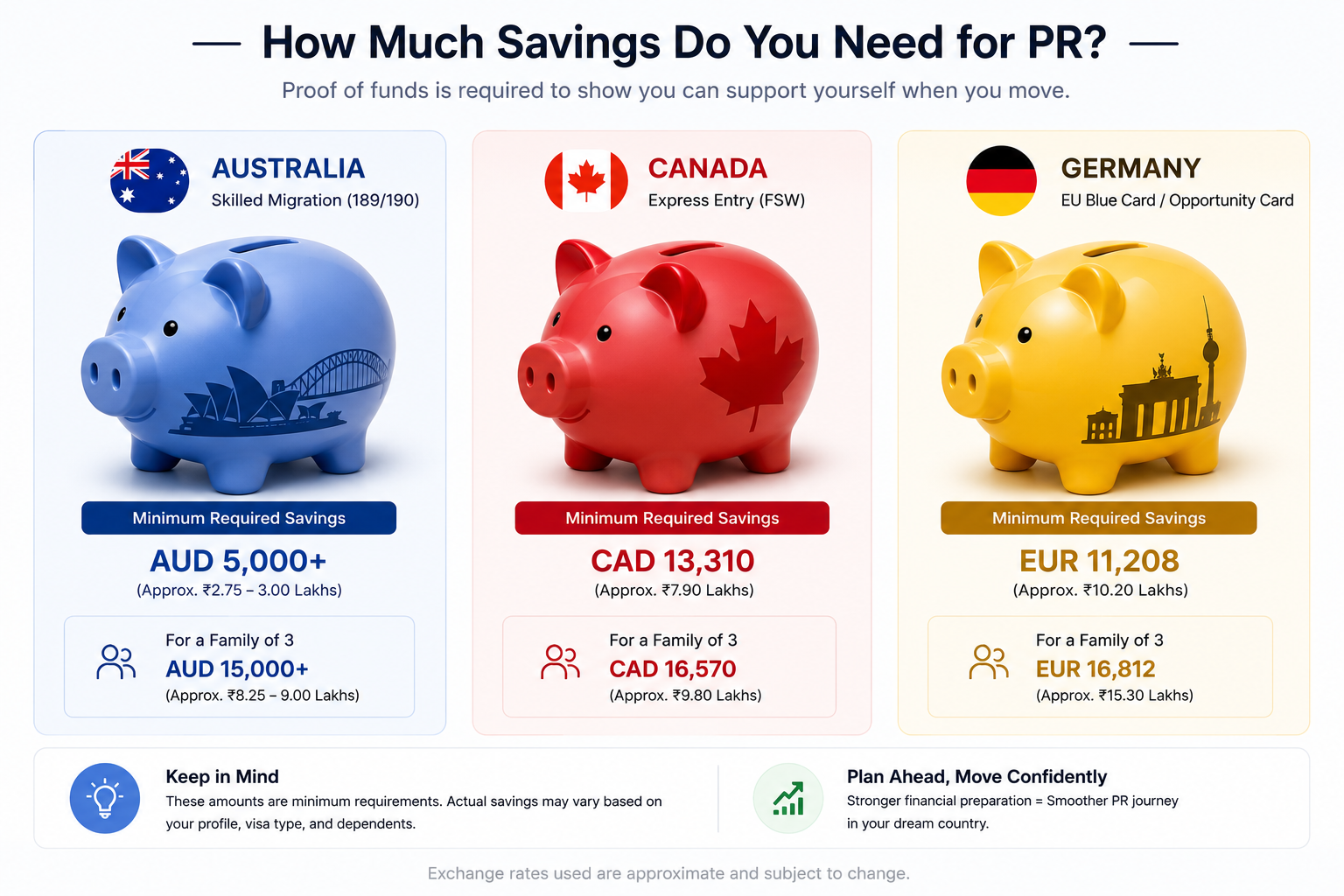
Applying for permanent residency without a job offer is possible in Australia, Canada, and Germany but each country has its own financial requirements. Understanding how much savings you need is critical before you apply.
Overview
Australia, Canada, and Germany all offer skilled migration pathways that do not strictly require a job offer. However, each country evaluates your financial readiness differently. Some rely on points-based systems, while others require proof of specific funds before issuing a visa.
This guide breaks down the savings requirements, key eligibility factors, and what applicants commonly overlook when applying without employer sponsorship.
Key Eligibility Requirements
Each country has baseline conditions you must meet before savings even become relevant.
Australia
- Skilled migration streams like the Subclass 189 (Skilled Independent) do not require a job offer
- You must receive an invitation through the SkillSelect points-based system
- No specific savings threshold is mandated, but you must demonstrate financial capacity to settle
- Health insurance and living costs are your responsibility upon arrival
Canada
- Express Entry (Federal Skilled Worker) does not require a job offer if you score competitively without one
- Proof of funds is a mandatory requirement for most Express Entry streams
- Funds must be unencumbered not borrowed or tied to a loan
- The amount required scales with the number of family members accompanying you
Germany
- The EU Blue Card and Skilled Worker visa typically require a job offer, but the Opportunity Card (Chancenkarte) allows job seekers to enter without one
- Applicants must show sufficient financial means to support themselves during the job search period
- A blocked account (Sperrkonto) is the standard method to demonstrate funds
- Health insurance coverage is mandatory before arrival
Application Process
- Assess your eligibility Determine which pathway suits your qualifications and whether a job offer is required for your specific stream.
- Calculate required savings Review the official government portal for the latest proof-of-funds thresholds applicable to your family size and chosen program.
- Open designated accounts Canada requires funds in a liquid bank account; Germany requires a blocked account with an approved German bank.
- Gather supporting documents Bank statements, pay slips, and financial history must typically cover the last three to six months.
- Submit your application File through SkillSelect (Australia), IRCC portal (Canada), or the German embassy or consulate in your home country.
- Maintain your funds Do not withdraw or reduce your savings during processing, as this can trigger a refusal.
Required Documents
- Official bank statements (typically last 36 months)
- Proof of account ownership with your full name and account number
- For Germany: Sperrkonto confirmation letter from an approved financial institution
- For Canada: Funds must be accessible and transferable fixed deposits accepted in some cases with evidence of liquidity
- Employment history or proof of skill assessment (varies by country)
- Valid passport and educational qualification certificates
- Health insurance documents (mandatory for Germany, recommended for Australia and Canada)
Benefits and Limitations
Benefits
- You retain full flexibility to choose your employer after arrival
- No dependence on a single employer for your immigration status
- Australia's Subclass 189 grants permanent residency directly without a job offer requirement
- Canada's Express Entry offers a clear, transparent points-based ranking system
- Germany's Opportunity Card provides a structured 12-month window to secure employment
Limitations
- Higher savings thresholds can be a barrier for single-income applicants
- Without a job offer, your points score in Canada's Express Entry may be lower, reducing your chances of receiving an Invitation to Apply (ITA)
- Germany's Opportunity Card does not itself lead directly to PR you still need to secure a qualifying job afterward
- Australia's points cutoffs fluctuate and are not guaranteed in advance
- Savings must often be maintained over a sustained period before and during application
Common Mistakes to Avoid
- Using borrowed funds: Money from personal loans or informal borrowing is not accepted as proof of funds in Canada or Germany
- Withdrawing savings mid-application: A drop in your balance during processing can lead to refusal
- Ignoring currency conversion: Funds held in a foreign currency must typically meet the threshold after conversion at official rates
- Not updating bank statements: Outdated statements older than six months are commonly rejected
- Underestimating living costs: Proof-of-funds requirements cover minimum thresholds actual settlement costs are typically higher
- Confusing streams: Not all Express Entry streams exempt you from a job offer verify your specific category before applying
Frequently Asked Questions
How much savings does Canada require for Express Entry without a job offer?
Canada's proof-of-funds requirement depends on your family size and is updated periodically by IRCC. For a single applicant, the amount is typically in the range of CAD 13,00014,000, but you should always verify the current figure on the official IRCC website before applying.
Does Australia require a specific savings amount for the Subclass 189 visa?
Australia does not publish a fixed savings threshold for the Subclass 189 visa. However, you are expected to demonstrate that you can financially support yourself and your dependants after arrival. Immigration officers assess this as part of the overall application.
What is a blocked account (Sperrkonto) for Germany's Opportunity Card?
A Sperrkonto is a restricted bank account held with a German financial institution. You deposit a set amount sufficient to cover living costs for your planned stay and can only withdraw a fixed monthly allowance. This proves to German authorities that you will not rely on public funds during your job search.
Can I apply for PR in Germany without a job offer?
Germany's Opportunity Card allows skilled workers to enter Germany for up to 12 months to search for a job, but it is not a direct PR pathway. You would need to secure qualifying employment and then apply for the appropriate residence permit, which can eventually lead to permanent residency.
Which country is easiest to get PR without a job offer if I have strong savings?
This depends on your qualifications, age, language scores, and work experience not savings alone. Canada's Express Entry and Australia's Subclass 189 both offer structured PR pathways without a mandatory job offer. Consulting a registered immigration professional will help you identify the most suitable option based on your full profile.
How Visas Avenue Can Help
Visas Avenue's experienced immigration consultants can evaluate your savings, skill profile, and eligibility across all three countries. We help you identify the right pathway, prepare accurate documentation, and avoid costly application errors giving your PR application the strongest possible foundation.
Conclusion
Savings play a different but critical role in PR applications for Australia, Canada, and Germany. Canada has a clearly defined proof-of-funds requirement, Germany requires a blocked account for job-seeker entrants, and Australia expects general financial preparedness. Understanding these distinctions before you apply can be the difference between a successful outcome and an avoidable refusal.






Anusha V. Ramani
A group of diligent team members I must say! Very prompt and thorough in their job. Would...

Varun Thomas
Got our Canada PR done and I must say they are really professionals and they know what...

Vinay Upadhaya
Co-operative and Trained Staff to handhold you throughout the process. Mr.Vinay Upadhyay

Runzhun Gangrade
Great service and good support from the entire team. We had a great experience working...

Aakanksha Singh Chauhan
Thank you so much for your help Mrigya & Arpita. You keen sense of dedication to my...

Sanjeev Sharma
Very Professional Consultancy, which has actual meaningful escalation Matrix system for...