
EU Blue Card vs Germany Opportunity Card: Which Needs a Job Offer and Which Doesn't
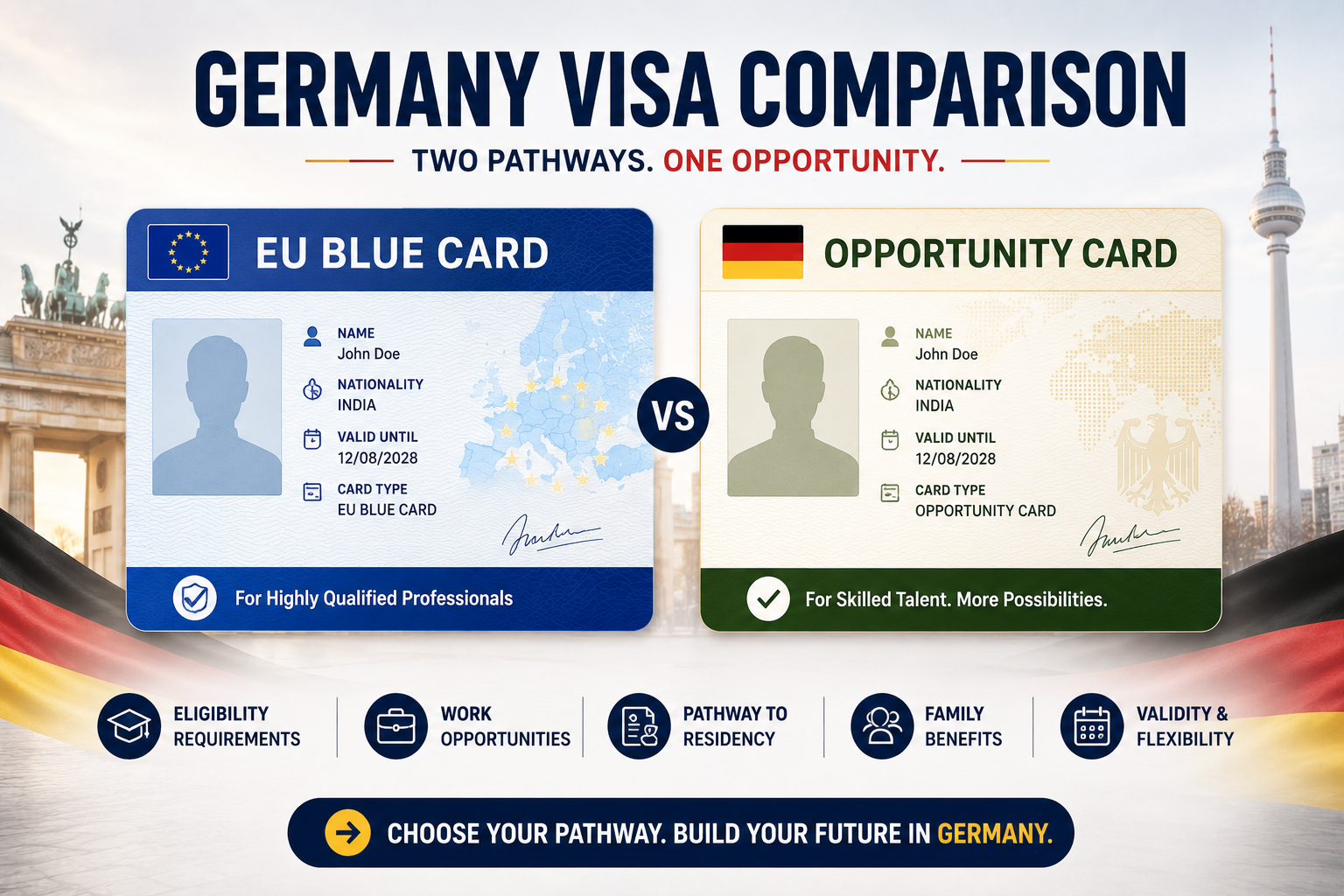
One of the most common questions skilled workers ask about moving to Germany is straightforward: do I need a job offer before I apply? The answer depends entirely on which visa route you choose. The EU Blue Card requires a confirmed job offer. The Germany Opportunity Card does not. Understanding the difference between these two pathways can save you months of confusion and help you make the right move.
Overview
Germany has two major work immigration routes for skilled professionals from outside the EU. Each serves a different stage of your career journey abroad.
- EU Blue Card: A work and residence permit for highly qualified professionals who already have a job offer in Germany meeting a minimum salary threshold.
- Germany Opportunity Card (Chancenkarte): A points-based visa that allows skilled workers to enter Germany and search for a job for up to one year. No prior job offer is required.
Both pathways lead to legal residence and work rights in Germany, but they start from very different positions.
Key Eligibility Requirements
EU Blue Card Requirements
- A recognised university degree or equivalent qualification
- A concrete job offer or employment contract from a German employer
- The job must match your field of qualification
- Salary must meet the minimum threshold set by German law (thresholds vary by occupation category and are updated periodically)
- The position must be in a skilled occupation
Germany Opportunity Card Requirements
- A recognised vocational or university qualification from your home country
- Must score sufficient points under the points-based system
- Points are awarded for: German language skills, work experience, age, previous stays in Germany, and a spouse with a qualifying profession
- Proof of sufficient funds to support yourself during your job search stay
- Basic German or English language ability is generally expected
Applicants who hold a qualification from a country with a bilateral recognition agreement with Germany may find the process smoother.
Application Process
Applying for the EU Blue Card
- Secure a qualifying job offer from a German employer
- Have your foreign qualification officially recognised in Germany if required
- Gather all required documents including your employment contract
- Submit your application at the German Embassy or Consulate in your home country
- Attend a visa interview if requested
- Upon arrival in Germany, register your address and collect your residence permit
Applying for the Germany Opportunity Card
- Check your eligibility using the points criteria under the Chancenkarte system
- Have your qualification assessed for recognition or equivalency
- Gather financial proof and supporting documents
- Apply at the German Embassy or Consulate in your home country
- Travel to Germany and begin your job search
- Once you secure employment, transition to a standard work permit or EU Blue Card
Required Documents
EU Blue Card Documents
- Valid passport
- Signed employment contract or binding job offer
- Recognised academic or professional qualification certificates
- Proof of qualification recognition where applicable
- Completed visa application form
- Passport-sized photographs
- Health insurance proof
Germany Opportunity Card Documents
- Valid passport
- Qualification certificates with certified translations
- Proof of financial resources for the stay
- Points calculation evidence (language certificates, work experience letters)
- Completed application form
- Health insurance or proof of coverage
- Passport-sized photographs
Benefits and Limitations
Benefits
- EU Blue Card: Fast-track to permanent residence, right to bring family members, freedom to work immediately, pathway to EU-wide mobility after meeting residence requirements
- EU Blue Card: Spouse receives an unrestricted work permit upon arrival
- Opportunity Card: No job offer needed before you arrive in Germany
- Opportunity Card: Allows you to attend interviews, network, and experience the German job market in person
- Opportunity Card: Can be converted to a work visa or EU Blue Card once employment is found
Limitations
- EU Blue Card: Requires a confirmed job offer before applying, which can take considerable time to secure from abroad
- EU Blue Card: Salary requirements may exclude entry-level or mid-range positions
- Opportunity Card: Does not permit full-time employment during the job search period, only limited trial work
- Opportunity Card: Financial self-sufficiency must be demonstrated throughout the stay
- Opportunity Card: No guarantee of finding employment within the permitted timeframe
Common Mistakes to Avoid
- Applying for the EU Blue Card before your job offer is formally confirmed in writing
- Submitting qualification documents without certified translations
- Underestimating the time needed for qualification recognition in Germany
- Confusing the Opportunity Card job search allowance with full work authorisation
- Not checking whether your occupation falls under a shortage or regulated profession category
- Failing to demonstrate sufficient funds when applying for the Opportunity Card
- Assuming your foreign degree is automatically recognised without going through the formal process
Frequently Asked Questions
Can I apply for the Germany Opportunity Card without a university degree?
Yes, in some cases. The Opportunity Card also considers recognised vocational qualifications. However, you must still meet the points threshold, and the type of qualification can affect how many points you receive.
If I come to Germany on the Opportunity Card and find a job, can I switch to the EU Blue Card?
Yes, if your new job and salary meet the EU Blue Card criteria, you can apply to convert your status from within Germany. This is one of the most practical pathways for skilled workers who want to explore the market before committing.
Does the EU Blue Card allow me to work in other EU countries?
After holding the EU Blue Card in Germany for a specified period, you may gain the right to move and work in other EU member states under certain conditions. The exact rules depend on current EU regulations and your individual circumstances.
How long can I stay in Germany on the Opportunity Card?
The Germany Opportunity Card is generally issued for up to one year. If you have not found employment by that time, the card cannot typically be extended for the same purpose.
Is German language ability mandatory for both visa types?
German language skills are not always mandatory for the EU Blue Card, especially in shortage occupations. For the Opportunity Card, language skills contribute points toward your eligibility score, though the minimum requirement depends on your overall points profile.
How Visas Avenue Can Help
Navigating the difference between these two Germany immigration pathways involves detailed document preparation, qualification recognition, and precise eligibility assessment. The Visas Avenue team works with skilled workers to evaluate which route suits their profile, prepare complete application packages, and avoid common errors that cause delays or rejections. Our consultants stay updated on German immigration requirements so you receive accurate and practical guidance at every step.
Conclusion
The EU Blue Card and Germany Opportunity Card are both valuable immigration routes, but they serve different needs. If you have a qualifying job offer in hand, the EU Blue Card offers a faster and more structured pathway. If you want to explore the German job market before committing, the Opportunity Card gives you the flexibility to do that. Understanding which route matches your current situation is the first step toward a successful move to Germany.




Anusha V. Ramani
A group of diligent team members I must say! Very prompt and thorough in their job. Would...

Varun Thomas
Got our Canada PR done and I must say they are really professionals and they know what...

Vinay Upadhaya
Co-operative and Trained Staff to handhold you throughout the process. Mr.Vinay Upadhyay

Runzhun Gangrade
Great service and good support from the entire team. We had a great experience working...

Aakanksha Singh Chauhan
Thank you so much for your help Mrigya & Arpita. You keen sense of dedication to my...

Sanjeev Sharma
Very Professional Consultancy, which has actual meaningful escalation Matrix system for...