
Canada PR Refused? Here Are Your Real Next Steps
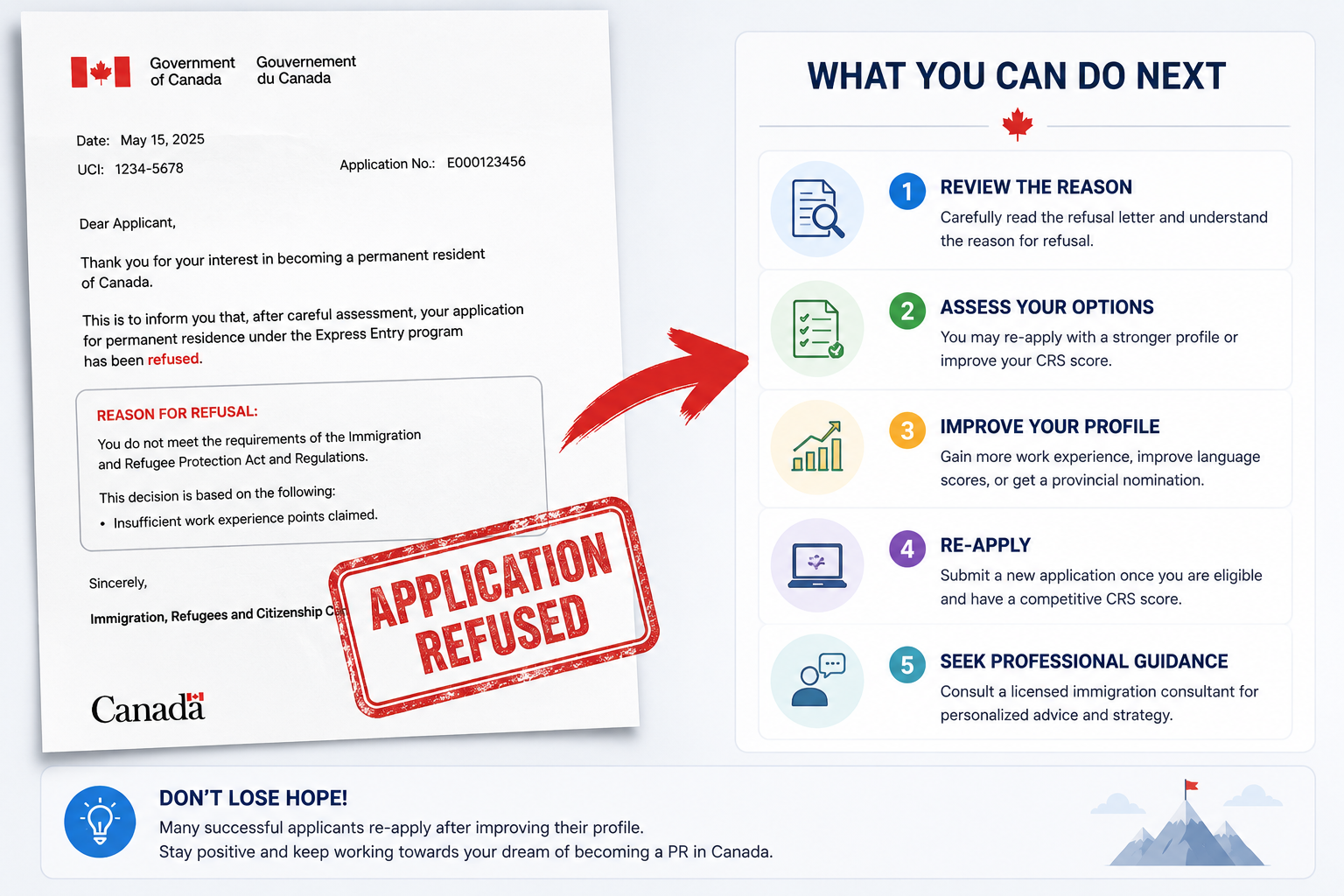
Receiving a Canada PR refusal is frustrating but it is not the end of your immigration journey. Many applicants who are refused the first time successfully obtain PR through a revised or alternative application. The key is understanding why you were refused and what your real options are.
Overview
A Canada Permanent Residence refusal means the immigration officer was not satisfied that you met the requirements of the program you applied under. The refusal letter will typically state the reasons, and those reasons directly determine your next steps.
Acting quickly and strategically matters. Some options have deadlines, and delays can limit your choices.
Key Eligibility Requirements to Review After Refusal
Before deciding on a next step, review whether you met the core requirements of your program at the time of application:
- Language scores: Did your IELTS or CELPIP results meet the minimum CLB requirement for your stream?
- Education credentials: Was your Educational Credential Assessment (ECA) valid and from an approved body?
- Work experience: Did your NOC code match your actual job duties? Was the experience properly documented?
- Medical and security clearance: Were all clearance requirements completed within validity periods?
- Proof of funds: Did you provide sufficient settlement fund documentation?
- Completeness of application: Were all forms filled correctly and all supporting documents included?
Application Process Your Next Steps After Refusal
- Read the refusal letter carefully. Identify every specific reason listed. This is your roadmap.
- Request your GCMS notes. Global Case Management System notes show what the officer reviewed and noted. This gives you deeper insight beyond the refusal letter.
- Consult a regulated immigration consultant or lawyer. A professional can assess whether the refusal was based on a legal error or a genuine gap in your application.
- Determine your option appeal, reconsideration, or reapplication. Not all refusals have the same remedy. Identify the right path before taking action.
- Gather stronger supporting documents. If reapplying, address each refusal reason with clear and complete evidence.
- Submit your appeal or new application within the required timeframe. Deadlines vary by program and appeal type do not delay.
Required Documents for Addressing a Refusal
The documents you need depend on your next step, but commonly include:
- Original refusal letter
- GCMS notes from your previous application
- Updated language test results (if scores were an issue)
- New or corrected ECA (if education was questioned)
- Updated employment reference letters with detailed job duties
- Revised proof of funds statements
- Any missing documents that were cited in the refusal
- A detailed cover letter addressing each refusal reason
Benefits and Limitations
Benefits
- A refusal does not permanently bar you from Canadian immigration in most cases
- GCMS notes provide transparency and help build a stronger reapplication
- Some programs allow you to reapply immediately after addressing the gaps
- Express Entry profiles can be updated and resubmitted with improved scores
- Provincial Nominee Programs (PNPs) may offer alternative pathways if federal streams are difficult
Limitations
- Not all refusals are eligible for an appeal options depend on the program
- Judicial review has strict timelines and is not guaranteed to succeed
- Reapplying without addressing the root cause is likely to result in another refusal
- Processing fees are generally non-refundable
- Some refusals, particularly on misrepresentation grounds, carry serious consequences including bans
Common Mistakes to Avoid
- Reapplying immediately without reviewing the refusal reasons this wastes time and money
- Ignoring GCMS notes these often reveal issues not fully explained in the refusal letter
- Submitting the same documents if documents caused the refusal, new or corrected versions are essential
- Missing appeal deadlines once a deadline passes, certain remedies are no longer available
- Not disclosing a previous refusal future applications require you to declare prior refusals honestly
- Assuming the officer made an error without evidence judicial review requires a clear legal basis
Frequently Asked Questions
Can I reapply for Canada PR after a refusal?
Yes, in most cases you can reapply. However, you must address the specific reasons for your refusal before submitting a new application. Reapplying without changes is unlikely to produce a different result.
What are GCMS notes and how do I get them?
GCMS notes are internal records of your immigration file, including officer comments. You can request them through an Access to Information and Privacy (ATIP) request submitted to Immigration, Refugees and Citizenship Canada (IRCC). Processing times vary.
Is there an appeal process for Express Entry refusals?
Express Entry refusals do not go through a standard immigration appeal tribunal. However, you may be eligible for judicial review at the Federal Court if there are grounds to believe the decision contained a legal error. A qualified immigration lawyer can advise you on this.
Does a PR refusal affect future visa or travel applications to Canada?
A refusal itself does not automatically ban future applications, but you are required to declare it. A refusal based on misrepresentation carries significantly more serious consequences and can affect future eligibility.
How long should I wait before reapplying after a Canada PR refusal?
There is generally no mandatory waiting period for reapplication unless a ban was imposed. However, you should take sufficient time to properly address all refusal reasons, gather stronger documents, and if needed, improve your language scores or other qualifying factors.
How Visas Avenue Can Help
At Visas Avenue, our regulated immigration consultants review refusal letters, obtain and analyze GCMS notes, and develop a clear strategy for your next step whether that is reapplication, an alternative pathway, or exploring appeal options. We handle the process with precision so your next application is as strong as possible.
Conclusion
A Canada PR refusal is a setback, not a dead end. With the right information, professional guidance, and a corrected application strategy, many applicants do go on to receive their PR. Take your refusal letter seriously, act on the reasons given, and get expert help before your next submission.


.png)



Anusha V. Ramani
A group of diligent team members I must say! Very prompt and thorough in their job. Would...

Varun Thomas
Got our Canada PR done and I must say they are really professionals and they know what...

Vinay Upadhaya
Co-operative and Trained Staff to handhold you throughout the process. Mr.Vinay Upadhyay

Runzhun Gangrade
Great service and good support from the entire team. We had a great experience working...

Aakanksha Singh Chauhan
Thank you so much for your help Mrigya & Arpita. You keen sense of dedication to my...

Sanjeev Sharma
Very Professional Consultancy, which has actual meaningful escalation Matrix system for...