
Canada PNP Eligibility: Which Province Matches Your Profile
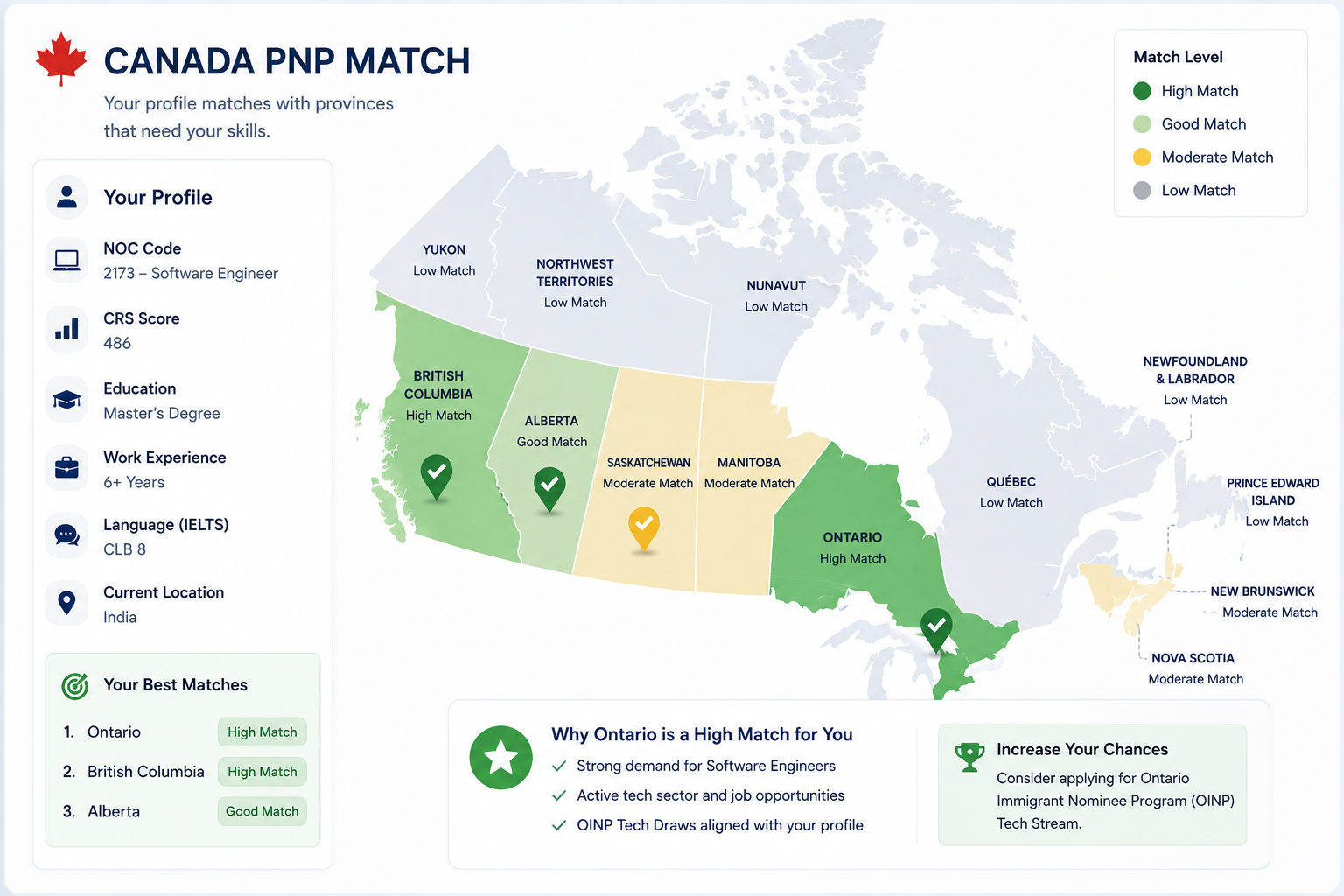
Canada's Provincial Nominee Program (PNP) is one of the most effective pathways to permanent residence but choosing the wrong province can cost you time and money. Each province has its own streams, criteria, and priorities. Matching your profile to the right program is the key to a successful application.
Overview
The PNP allows Canadian provinces and territories to nominate individuals who meet their specific labor market and settlement needs. A provincial nomination adds 600 points to your Express Entry profile or provides a direct pathway outside the federal system.
There are two main application routes under PNP:
- Enhanced PNP: Linked to Express Entry; nomination adds 600 CRS points
- Base PNP: Paper-based process; operates independently from Express Entry
Key Eligibility Requirements
Requirements vary by province and stream, but most programs look for:
- Relevant work experience in an in-demand occupation
- Educational qualifications meeting provincial standards
- Proof of language proficiency (IELTS or equivalent)
- A valid job offer from a provincial employer (for many streams)
- Intent to settle and work in the nominating province
- Sufficient settlement funds
- Admissibility to Canada (no criminal or medical inadmissibility)
Which Province Matches Your Profile
Below is a practical guide to help you identify the province most aligned with your background.
| Province | Best Suited For | Key Streams |
|---|---|---|
| Ontario | Skilled workers, international students, tech professionals | Human Capital Priorities, Employer Job Offer, Masters Graduate |
| British Columbia | Tech workers, healthcare professionals, trades | Skills Immigration, Express Entry BC, Tech Pilot |
| Alberta | Engineers, IT professionals, rural workers | Alberta Advantage Immigration Program (AAIP) |
| Saskatchewan | Skilled workers, international graduates, farm owners | Saskatchewan Immigrant Nominee Program (SINP) |
| Manitoba | Workers with Manitoba ties, international graduates | Skilled Workers in Manitoba, International Education Stream |
| Nova Scotia | Healthcare, hospitality, skilled trades | Nova Scotia Nominee Program (NSNP), Labour Market Priorities |
| New Brunswick | Entrepreneurs, skilled workers with job offers | Strategic Initiative Stream, Skilled Workers Stream |
| Prince Edward Island | Skilled workers, international business experience | PEI PNP Labour Impact, Business Impact |
Application Process
- Assess your eligibility: Review your NOC code, education, language scores, and work experience against provincial criteria.
- Select your target province and stream: Match your profile to the most suitable program based on your occupation and situation.
- Create or update your Express Entry profile: Required for Enhanced PNP streams linked to federal immigration.
- Submit an Expression of Interest (EOI): Many provinces run their own EOI pools and invite candidates periodically.
- Receive a Nomination: If selected, you will receive a provincial nomination letter.
- Apply for Permanent Residence: Submit your PR application to IRCC either through Express Entry or via paper-based process.
Required Documents
While exact requirements differ by province and stream, you will typically need:
- Valid passport copies
- Educational credential assessment (ECA)
- Language test results (IELTS, CELPIP, TEF)
- Employment reference letters and pay stubs
- Job offer letter (where applicable)
- Proof of settlement funds
- Police clearance certificates
- Provincial nomination certificate (for PR stage)
Benefits and Limitations
Benefits
- Provides a structured pathway to Canadian PR outside of federal draws alone
- Enhanced PNP nominees receive 600 additional CRS points virtually guaranteeing an ITA
- Multiple streams cater to skilled workers, graduates, entrepreneurs, and semi-skilled workers
- Allows candidates with lower CRS scores to still achieve permanent residence
- Supports regional settlement and faster labor market integration
Limitations
- Nominees are generally expected to settle in the nominating province
- Some streams require a valid job offer, which can be difficult to secure remotely
- Processing timelines vary significantly between provinces
- Provinces open and close streams based on labor market needs availability is not guaranteed
- Base PNP paper-based applications can take longer than Express Entry routes
Common Mistakes to Avoid
- Applying to a province without verifying your NOC code is in demand there
- Submitting an incomplete Expression of Interest with missing or inaccurate information
- Ignoring provincial residency intent requirements after nomination
- Failing to meet language score thresholds for the specific stream
- Not getting an Educational Credential Assessment before applying
- Applying to multiple provinces simultaneously without understanding their individual rules
- Missing document deadlines after receiving a nomination
Frequently Asked Questions
Can I apply to more than one provincial program at the same time?
Yes, in most cases you can apply to multiple provinces simultaneously. However, each province has its own rules regarding active applications, so review individual program guidelines before proceeding.
Do I need a job offer to apply under the PNP?
Not always. Many streams do not require a job offer particularly Human Capital streams and graduate streams. However, employer-driven streams do require a valid, full-time job offer from a provincial employer.
How does a provincial nomination affect my Express Entry score?
A valid provincial nomination under an Enhanced PNP stream adds 600 Comprehensive Ranking System (CRS) points to your profile. This effectively guarantees you will receive an Invitation to Apply (ITA) in the next available Express Entry draw.
What is the difference between Enhanced PNP and Base PNP?
Enhanced PNP streams are integrated with the federal Express Entry system. Base PNP streams operate independently through a paper-based process and are not connected to Express Entry, though they still lead to Canadian permanent residence.
How long does the PNP process take from start to PR?
Timelines vary depending on the province, stream, and application volume. Enhanced PNP applications processed through Express Entry are generally faster than Base PNP paper-based applications. It is best to check the current processing estimates on the official provincial and IRCC websites.
How Visas Avenue Can Help
Navigating the PNP requires a thorough understanding of your profile and provincial requirements. At Visas Avenue, our regulated immigration consultants assess your qualifications, identify the most suitable provincial stream, and manage your application from start to finish reducing errors and improving your chances of a successful outcome.
Conclusion
Canada's PNP offers multiple tailored pathways to permanent residence across different provinces. Matching your skills, education, and work experience to the right provincial program is the most important step you can take. Start with a professional eligibility assessment to ensure your efforts are directed toward the stream most likely to succeed.






Anusha V. Ramani
A group of diligent team members I must say! Very prompt and thorough in their job. Would...

Varun Thomas
Got our Canada PR done and I must say they are really professionals and they know what...

Vinay Upadhaya
Co-operative and Trained Staff to handhold you throughout the process. Mr.Vinay Upadhyay

Runzhun Gangrade
Great service and good support from the entire team. We had a great experience working...

Aakanksha Singh Chauhan
Thank you so much for your help Mrigya & Arpita. You keen sense of dedication to my...

Sanjeev Sharma
Very Professional Consultancy, which has actual meaningful escalation Matrix system for...