
Australia PR for IT Professionals: Free Eligibility Check for Tech Roles
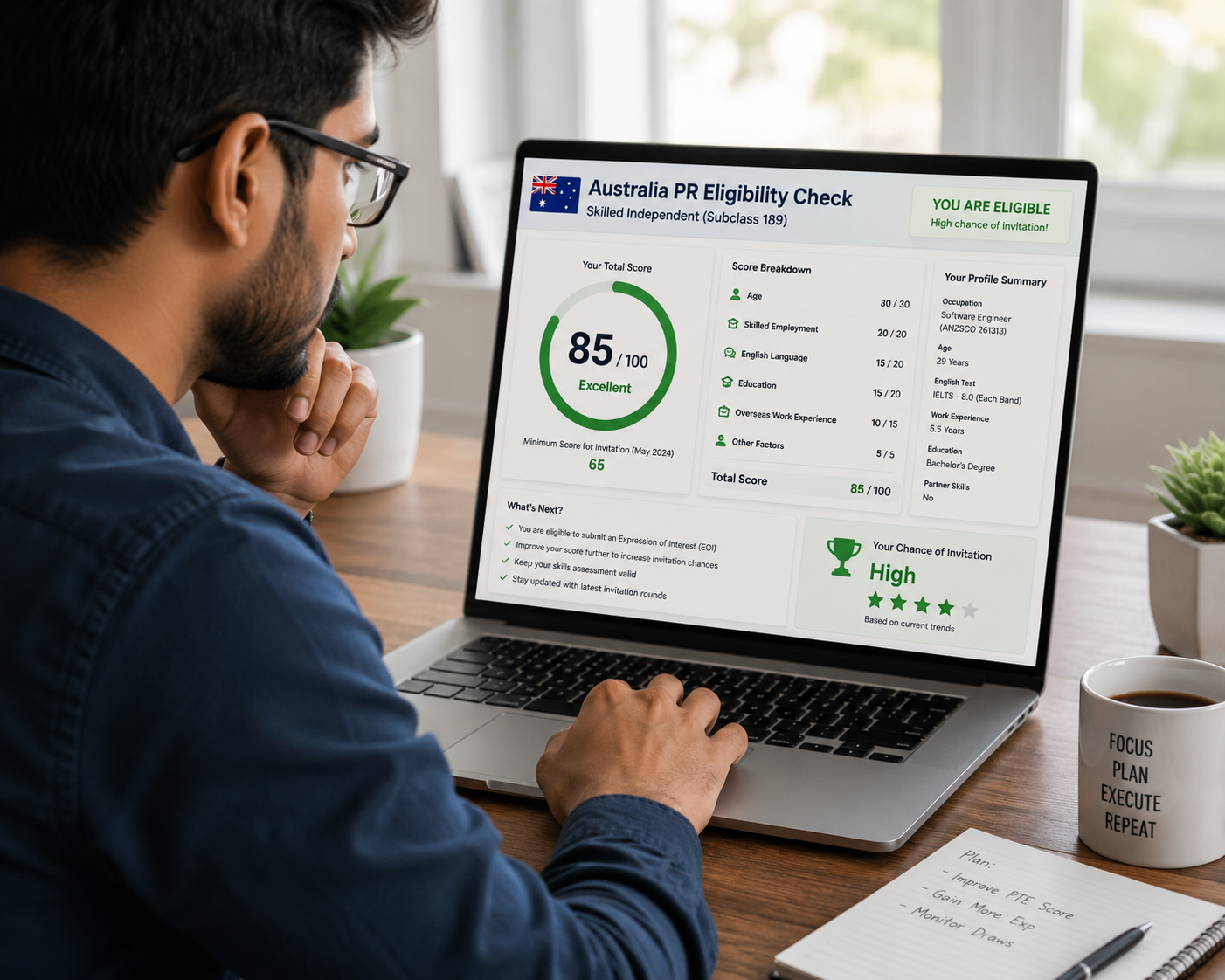
Australia continues to welcome skilled IT professionals through its points-based permanent residency pathways. If you work in software development, cybersecurity, data science, or another tech role, you may already meet the core requirements for Australian PR. This guide breaks down exactly what you need to know and how to check your eligibility.
Overview
Australia's skilled migration program is designed to fill gaps in its domestic workforce. The technology sector consistently features across key occupation lists, making IT professionals strong candidates for permanent residency.
The most relevant visa subclasses for tech workers are the Subclass 189 (Skilled Independent), Subclass 190 (Skilled Nominated), and Subclass 491 (Skilled Work Regional). Each pathway has distinct requirements but shares a common points-based assessment structure.
Key Eligibility Requirements
Before applying, you must confirm that you meet the foundational criteria across several areas.
- Occupation eligibility: Your nominated occupation must appear on a relevant skilled occupation list and fall under an eligible ANZSCO code.
- Skills assessment: You must obtain a positive skills assessment from the relevant assessing authority. For most IT roles, this is ACS (Australian Computer Society).
- Age: Applicants must generally be under 45 years of age at the time of invitation.
- English language proficiency: A minimum score in a recognised test such as IELTS, PTE, or TOEFL is required. Higher scores contribute additional points.
- Points test score: You must meet the minimum points threshold. Points are awarded for age, English ability, work experience, qualifications, and other factors.
- Work experience: Relevant skilled employment, both within and outside Australia, can contribute to your points score.
- Health and character: All applicants must meet Australian health and character requirements.
Application Process
The pathway to Australian PR for IT professionals follows a structured sequence. Understanding each step helps you plan your timeline effectively.
- Confirm your occupation: Verify your job role maps to an eligible ANZSCO code on the relevant skilled occupation list.
- Get a skills assessment: Apply to ACS (or another relevant body) for a formal assessment of your qualifications and work experience.
- Take an English language test: Complete an approved English test and aim for the highest score possible to maximise your points.
- Calculate your points score: Use the official points calculator to estimate your score across all categories.
- Submit an Expression of Interest (EOI): Lodge your EOI through the SkillSelect system. You are not applying for the visa at this stage.
- Receive an Invitation to Apply (ITA): If selected in a draw, you will receive an ITA for the relevant visa subclass.
- Lodge the visa application: Submit your full application with supporting documents within the specified timeframe after receiving the ITA.
- Await a decision: A case officer will assess your application. You may be asked for additional information.
Required Documents
Preparing your documents early reduces delays at the application stage. Commonly required documents include:
- Valid passport and identity documents
- ACS skills assessment outcome letter
- English language test scorecard
- Educational qualification certificates and transcripts
- Employment reference letters detailing your role, responsibilities, and duration
- Payslips or tax records as supporting employment evidence
- Health examination results from an approved panel physician
- Police clearance certificates from all countries of residence
- Proof of nomination (for Subclass 190 and 491 applicants)
Benefits and Limitations
Benefits
- Permanent residency status with a pathway to Australian citizenship
- Right to live and work anywhere in Australia (Subclass 189 and 190)
- Access to Medicare, Australia's public healthcare system
- Ability to sponsor eligible family members
- Strong job market demand across technology roles in major Australian cities
- No requirement for employer sponsorship under the independent skilled stream
Limitations
- The points-based system is competitive, and invitations are not guaranteed
- Skills assessments and visa fees represent a significant upfront financial commitment
- ACS assessments have specific requirements around qualifications and experience that not all applicants meet
- Subclass 491 requires living and working in a regional area for a specified period before applying for permanent residence
- Occupation lists can change, and roles that are eligible today may not remain on the list indefinitely
Common Mistakes to Avoid
Many skilled IT applicants face avoidable setbacks due to the following errors.
- Incorrect ANZSCO code selection: Choosing the wrong occupation code can lead to a failed skills assessment or an incorrect points claim.
- Weak employment references: Reference letters that lack detail about your duties and seniority are frequently rejected or downgraded by assessing authorities.
- Underestimating English test preparation: A higher English score can significantly improve your points total. Many applicants attempt the test without adequate preparation.
- Missing document deadlines: Once you receive an ITA, you have a fixed window to lodge your application. Missing this window means starting over.
- Claiming ineligible work experience: Only work performed at the skill level required by your nominated ANZSCO code is assessable. Unrelated roles or roles at a junior level may not qualify.
- Not seeking professional advice: Attempting to navigate the process without guidance often results in costly errors or unsuccessful outcomes.
Frequently Asked Questions
Which IT occupations are commonly eligible for Australian PR?
Roles such as software engineer, ICT business analyst, systems analyst, network engineer, cybersecurity specialist, and database administrator are among the occupations that frequently appear on skilled occupation lists. Eligibility depends on your specific ANZSCO code and current list inclusions, so always verify before proceeding.
Do I need an Australian job offer to apply for a skilled independent visa?
No. The Subclass 189 skilled independent visa does not require a job offer or employer sponsorship. However, having Australian work experience can contribute additional points to your score.
What is the role of ACS in the PR process?
The Australian Computer Society (ACS) is the designated skills assessing authority for most ICT occupations. A positive ACS assessment confirms that your qualifications and experience are comparable to Australian standards and is a mandatory step before you can lodge an EOI.
Can I include overseas work experience in my points claim?
Yes. Overseas skilled employment in your nominated occupation can contribute points under the points test. The number of points awarded depends on the number of years of overseas experience you have accumulated.
What happens if my occupation is not currently on the skilled occupation list?
If your specific role is not listed, you will not be able to submit an EOI under the general skilled migration program. In this situation, alternative pathways such as employer-sponsored visas or state-specific programs may be worth exploring with a registered migration agent.
How Visas Avenue Can Help
Visas Avenue provides end-to-end support for IT professionals pursuing Australian PR. Our registered migration agents assess your profile, identify the most suitable visa pathway, and guide you through every stage from skills assessment to visa lodgement.
Start with a free eligibility check to understand your options before committing to any step. Our team reviews your occupation, qualifications, experience, and English scores to give you a clear, personalised assessment.
Conclusion
Australia PR is an achievable goal for qualified IT professionals who understand the process and prepare thoroughly. The key is to verify your occupation eligibility early, secure a strong skills assessment, and build the highest possible points score before lodging your EOI.
Take the first step today with a free eligibility check from Visas Avenue and get expert clarity on your pathway to Australian permanent residency.






Anusha V. Ramani
A group of diligent team members I must say! Very prompt and thorough in their job. Would...

Varun Thomas
Got our Canada PR done and I must say they are really professionals and they know what...

Vinay Upadhaya
Co-operative and Trained Staff to handhold you throughout the process. Mr.Vinay Upadhyay

Runzhun Gangrade
Great service and good support from the entire team. We had a great experience working...

Aakanksha Singh Chauhan
Thank you so much for your help Mrigya & Arpita. You keen sense of dedication to my...

Sanjeev Sharma
Very Professional Consultancy, which has actual meaningful escalation Matrix system for...